
New research at Norton Healthcare’s Wendy Novak Diabetes Institute seeks to win the war on type 1 diabetes
LOUISVILLE When you put a team together to beat diabetes, you look for only the best in doctors and technology.
Kyle Brothers, MD, the chief scientific officer for Norton Children’s Research Institute and executive vice chair for the University of Louisville department of pediatrics, says researching ways to defeat type 1 diabetes meant finding the best talent who could use the latest in technology.
“In research of this type, you don’t know which technology is going to win,” he says. “When we develop a research program like this, we try to build a program that creates opportunities for whatever could turn out to be the best thing and to make sure that our patients have access to it. It’s like recruiting a team to win the Super Bowl; you invest in a lot of pieces.”
Brothers says investing in new people and new technologies meant looking into islet cell transplantation techniques and the doctors and researchers who could perform them.
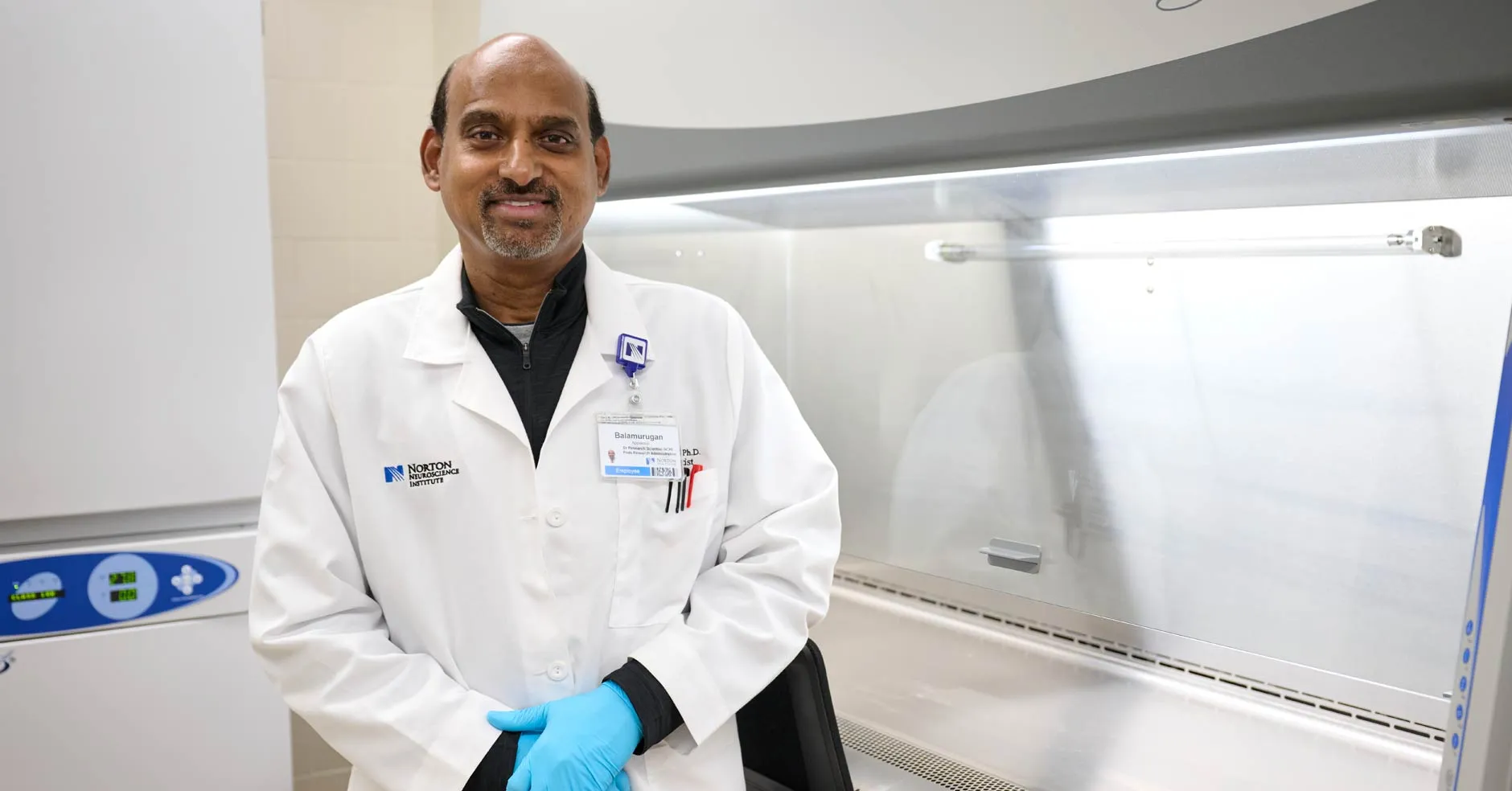
That’s where Balamurugan N. Appakalai, PhD, also known as Dr. Bala, came in. Bala says curing diabetes using islet cell therapies is his passion.
“Our observations are very new even to the scientific world,” he says. “I don’t want to see patients suffering from painful insulin injections. I think our islet transplantation therapy really helps those who are suffering. So, it’s my passion and I want to continue to provide services from the knowledge and experience that I gained from the last 30 years and more.”
Meet Dr. Bala
As an isletologist, Bala’s work with the therapy started during his studies for his master’s degree when he tested anti-diabetic extracts in animal models. Bala grew up in Tamil Nadu, South India, near Madurai, where he received his bachelor’s degree in biology. Later, after receiving his master’s degree in medical physiology and his PhD in islet cell transplantation from Christian Medical College in Vellore, India, he traveled to Kyoto University in Japan for post-doctoral training in islet transplant research.
After numerous experiments with monkey and pig islet cells for xenotransplantation, he transferred to the University of Pittsburgh where he was able to work with human islet cells.
Bala served more than five years as the co-director of islet core research and assistant professor in Pittsburgh before moving to the University of Minnesota in Minneapolis, a leading school for work with the pancreas and for islet cell transplants. There he served as director of islet core and performed more than 400 clinical islet auto-transplantations and 50 clinical islet cell allotransplants, including NIH-funded clinical islet transplant (CIT) Phase 3 clinical trials.
In 2014, Bala helped establish an islet cell research program at the University of Louisville. In 2024, he joined the Norton Islet Cell Research and Transplant Program within the Wendy Novak Diabetes Institute.
“Norton Healthcare and Norton Children’s are very interested in this diabetes research,” he says. “They are helping me in every stage of our clinical transplant aspect, so we have been able to involve several different departments as we prepare to do our first transplants. Norton Healthcare has worked to build an interdisciplinary team including surgical, anesthesia, gastrointestinal, and pain management support.”
Innovation in Islet Cell Transplantation
The Norton Islet Cell Research and Transplant Program is funded through nearly $4 million in grants from the Norton Children’s Hospital Foundation, supported by community donors and lead gifts from the James and Judith K. Dimon Foundation and the Lift a Life Novak Family Foundation. It is one of only 11 programs of its kind in the country.
Its newest GMP lab, which is opening this year, is a 525 square foot clean room space designed specifically for islet cell production for transplantation.
During the first phase of the program, patients suffering from chronic pancreatitis will have their diseased pancreas removed. This results in the patient developing diabetes. The pancreas is then processed in this specialty lab, where functional islet cells are isolated from the pancreas and then infused back into the patient’s liver where it should begin producing insulin again.
Those involved with the program expect the first phase, and the first procedure of this type, should occur later in 2026 once the first patient is selected. Phase two will see clinical trials assessing the effectiveness and safety of transplanting the islet cells from donors into type 1 diabetes patients in 2027-2028.
The Norton Islet Cell Research and Transplant Program includes two additional state-of-the-art labs that opened in 2024, which Bala’s team uses to advance new therapies centered around islet cell transplantation. There, they refine the techniques needed to prepare and extract islet cells from donor pancreases — expertise that will directly support upcoming clinical phases and that they hope, help move the field closer to a cure for diabetes.
“This work is laying the foundation for future therapies that could expand treatment options for people with type 1 diabetes,” Bala says.
If the first two phases of the program prove successful, phase three could help position donor islet cell transplants as an FDA-approved standard of care for individuals with type 1 diabetes. Leaders with the program hope this phase could begin in 2028–2029, but the timeline will rely on strong outcomes from the Norton Islet Cell Research and Transplant program and from additional clinical trials underway at other U.S. centers.
“I have decades of experience in this field, but we’re constantly refining our processes so that when our clinical trials begin, we’re fully prepared to deliver the best possible outcomes for patients,” Bala says.
Impact for Kentuckiana Adults and Children
It’s an important topic for a Kentucky healthcare system, doctors say, because diabetes is a significant health concern across the state. More than 500,000 Kentuckians, about 15 percent of the state’s adult population, are diagnosed with diabetes, and between 18,000 and 25,000 Kentuckians are living with type 1 diabetes.
Still there is much to learn, Bala says, which is the focus of his continuing work in the field. Even more pressing to him is the work to help people overcome type 1 diabetes.
“My goal is to dedicate my career to understanding what drives diabetes, improving how we treat it, and helping move us toward a future where children and adults no longer face the burden of this disease,” Bala says.
Meet Kyle Brothers, MD
For pediatrician Brothers, the therapies for children are an important part of the research at the Institute.
Brothers was raised in a family deeply involved in medicine in Maysville, Kentucky. After receiving a bachelor’s degree from Centre College in Danville, Kentucky, he received his medical degree from the University of Louisville School of Medicine. He did his residency and chief residency at Vanderbilt Children’s Hospital in Nashville. After his residency, he obtained his PhD in medical ethics at Vanderbilt University.
He says his vision has always been patient oriented.
“When I started medical school, I thought I would be a small-town family doctor,” he says. “My grandfather, Mitchell Denham, and his brother Harry Denham started the Denham Clinic in Maysville. He was an inspiration for me. He would go see patients in his car, going from house to house. In my mind, that’s what a doctor’s career was like. When I went to medical school, I thought I was going to be like my granddad.”
In medical school, Brothers learned that his passion was in pediatrics. His love of children and pediatric medicine helped change his view of what a doctor is, he says. Focusing on research helped him address problems he wanted to find solutions for. As part of Norton Children’s Research Institute, he was able to get involved with the research aspect of pediatric medicine.
That involvement led him to the Wendy Novak Diabetes Institute. The Institute’s leadership in research helped develop the islet cell research program as a way to beat type 1 diabetes in children and adults.
To be successful, he says, “The program has to be focused, but flexible.”
For Brothers, working toward a cure for type 1 diabetes is the ultimate goal.
“Every patient, no matter what pump they’re on, no matter what kind of strategy they use for managing their blood sugar, they still can’t match the blood-sugar control of someone without diabetes,” he says. “Our goal is to solve the practical challenges so transplanted cells can thrive and do their job. If we can do that, this approach has the potential to function as a true cure for type 1 diabetes. That’s what we’re working toward.”