
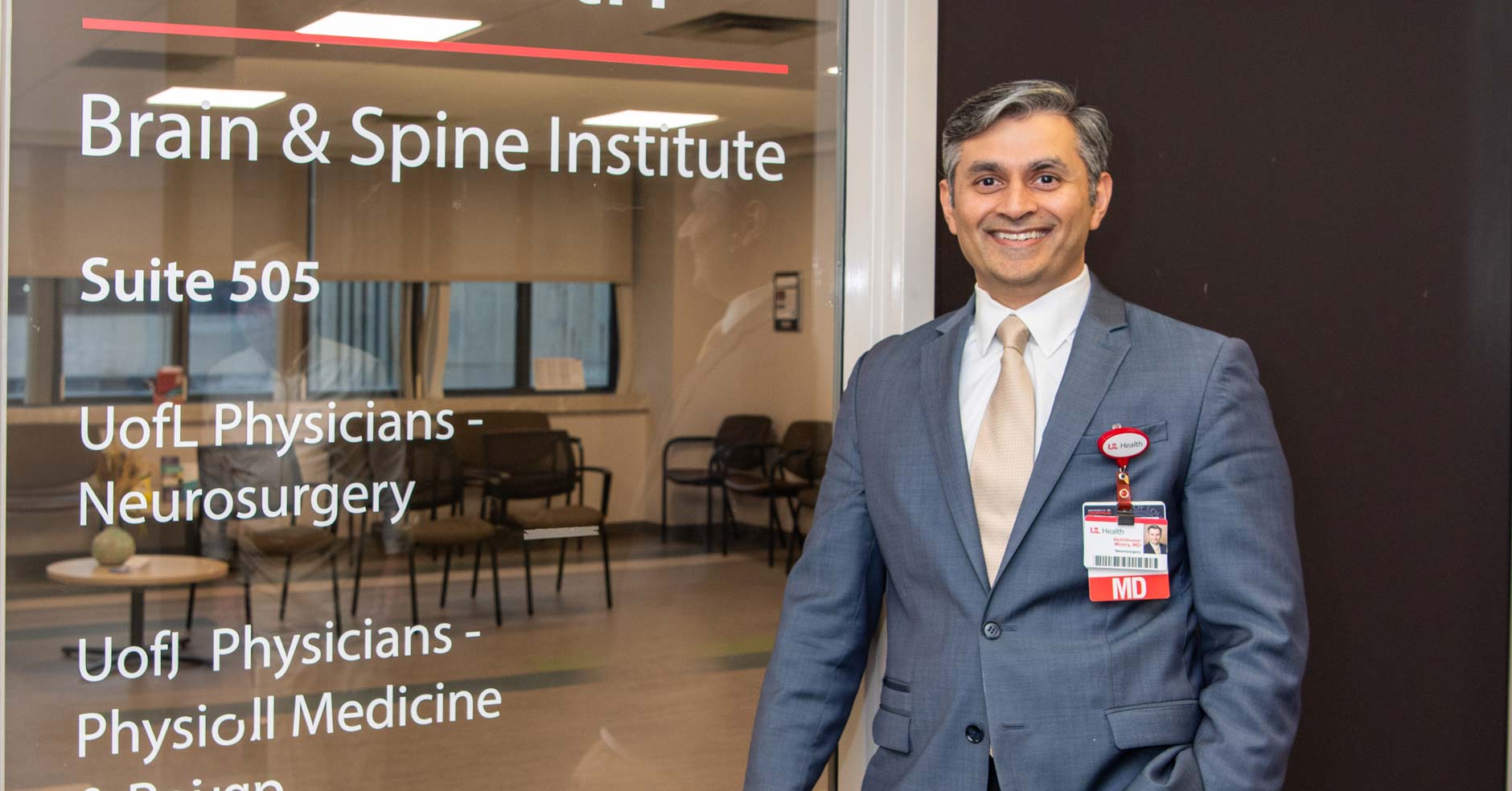
Akshitkumar Mistry, MD, employs research and hands-on procedures to aid brain cancer patients at UofL Health
LOUISVILLE When someone hears the words “You might have a brain tumor,” their life changes in an instant. Decisions must be quick, treatments precise, and outcomes—good or bad—often arrive faster than anyone would like. For Akshitkumar Mistry, MD, a neurosurgeon at UofL Health, that urgency is exactly what drew him to this work.
“There are no known causes for most brain cancers,” Mistry says. “I see people who haven’t engaged in the lifestyle habits that we normally link to cancer. They didn’t smoke, they ate well, they avoided drugs, sun damage, and known carcinogens, and they often have no family history. Yet, they still find themselves suffering from one of the most serious and grave cancers. Most people don’t realize that Kentucky has one of the highest brain tumor rates in the country.”
“I am a person who responds to instant gratification. If I were to, for example, transplant a liver into a patient who needs it, it may take months for me to know if my patient is feeling better. I don’t like that,” Mistry says. “But, if I manipulate the nervous system, I know instantly if I am helping or hurting my patient. That immediate feedback is very appealing to me.”
A Calling Built on Fast Decisions and Instant Feedback
Many doctors wait weeks to months to see whether a treatment helped. Neurosurgeons often get answers in seconds to days. The instant nature of the nervous tissue, the nervous system, the brain, the spinal cord, and the nerves appealed to Mistry and led him to pursue a career in neurosurgery. This appeal came early for him. His parents were blue-collar workers who experienced periods of unemployment when factories or businesses closed or laid off workers. Mistry wanted a degree that would offer him flexibility and the ability to find employment quickly.
“I wanted to obtain an education that would allow me to find jobs easily and quickly. A medical degree seemed very versatile and would make me employable,” he says.
Born in India and raised in Zambia, Mistry moved with his family to rural southwest Virginia as a teenager. He volunteered everywhere—hospitals, clinics, even the morgue. He liked the medical environment, even when it didn’t like him. He’s a neurosurgeon today, but back when he stepped in to his first operating room visit, he fainted!
“I also threw up,” he admits, laughing. That didn’t stop him from graduating from the University of Virginia and earning his medical degree at Vanderbilt University’s School of Medicine in 2013. He completed his neurological surgery residency at Vanderbilt University Medical Center and performed a brain tumor research fellowship at Vanderbilt.
Upon completing his fellowship, Mistry joined UofL Health and University of Louisville as an assistant professor in the Department of Neurological Surgery—drawn by its academic mission.
“I’m truly happiest in academia—teaching, researching tumor and treatments, and helping patients who need surgery,” Mistry says of his decision to come to UofL Health. The move also reunited him with Joseph Neimat, MD, chair of the Department of Neurological Surgery at the University of Louisville School of Medicine, who had been his training mentor during his neurosurgical training at Vanderbilt.
Surgery to Protect Humanity, Not Just the Brain
“There are a few things that make our brain tumor program special,” Mistry says.
Mistry gives the example of operating on patients who are fully awake during surgery. This allows Mistry to test the different functions of the patient. He recalls a patient who wanted to be able to keep reading sheet music.
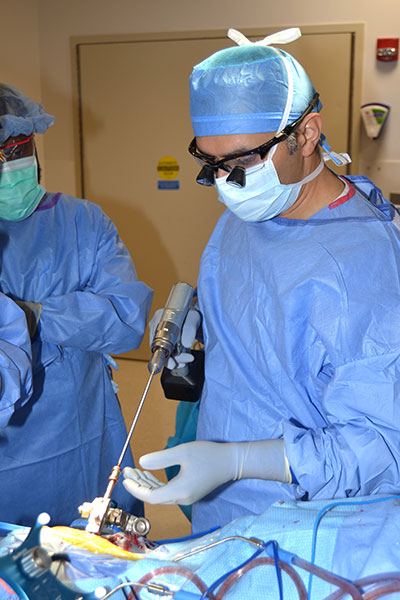
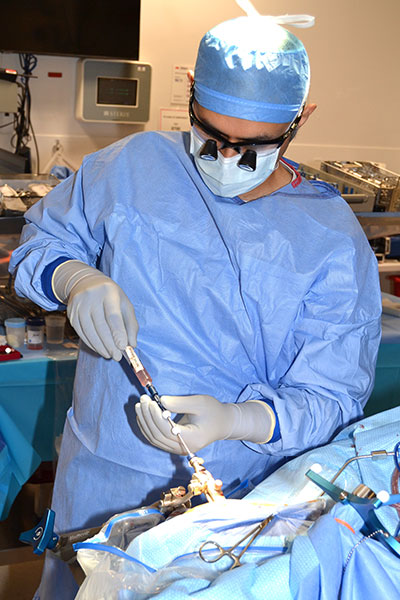
To ensure that the surgery did not interfere with this ability, the surgical team provided music sheets for the patient to read during the procedure to remove the tumor.
“It was successful,” says Mistry. “The patient read sheets of music while we removed his brain tumor.”
“One family feared that brain tumor surgery might take something essential from their loved one—his wit, his personality, his spark. So during the awake surgery, he cracked fresh jokes and fired playful digs at every one of his family members—and there were many—as I removed his brain tumor. After the surgery, as I relayed the jokes and jabs to the family one by one, they laughed with happy tears. Each jab at them convinced them that despite the brain surgery, their old wisecracker was still very much the rascal they loved.”
Most of Mistry’s patients are between the ages of 55 and 75 with no strong bias toward male or female. His patients present with headaches, seizures, weakness on one side or the other, difficulty speaking, discoordination, and imbalance.
“These symptoms are acute,” Mistry says. “Most often, they come to the emergency room because they think they are having a stroke or a seizure. The majority of my patients come because of an acute problem.”
For those patients who are diagnosed with a malignant brain cancer, it is an acute problem with a likely tragic outcome. For Mistry, the challenge is to comfort them while being open and honest about their condition.
“They are seeing me at a time of vulnerability. They are scared, and they have been told that they may have a brain tumor,” Mistry says. “One of the first things I do is try to make the moment as calm, controlled, and clear for them as possible. I show them their brain and where the lesion is and what is and is not concerning.”
Mistry outlines the patient’s options, which range from doing nothing to nonsurgical methods of testing such as blood tests, brain fluid analysis, and secondary imaging. Other options are to biopsy the brain or to perform surgery in an attempt to remove as much of the tumor as possible.
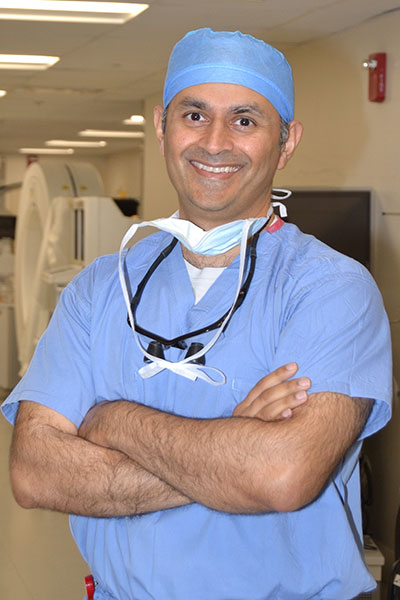
“We talk through the risks and benefits of everything,” Mistry says. “They deserve the truth, even if it’s hard.” He also discusses the possibility of participating in research and clinical trials.
“The patients have the choice of participating in research, which can be empowering,” Mistry says. “They can donate their time or brain tumor for research. With this act of courage and generosity, my patients become partners in the mission to understand brain cancer, find therapy, and advocate. They feel empowered knowing they at least helped others. Even in the last months of their lives, they often continue to participate in research. You know, survival stories are powerful, but what often goes untold are the stories of patients who pass away, leaving gifts—in form of their time, brain tumor tissue, and reports on how they did—in the most difficult time of their lives—gifts that quietly advance medicine.”
Mistry says that 90 percent of his patients participate in the research which he and his team conduct. Many also participate in clinical trials testing new drugs, new types of radiation, or new surgical approaches as part of the Cancer Trials Program at UofL Health—Brown Cancer Center.
“Most of the patients are looking to see if they are eligible for a new cutting-edge treatment,” Mistry says.
Research and Teaching
The research is essential because little progress has been made in the treatment of malignant brain cancers. The majority of Mistry’s patients have cancers in other parts of the body that spread to the brain. The second most common group of patients he sees—about 30 to 40 percent—has glioblastoma, which is the most common malignant brain cancer.
“For most cancers, there have been great scientific advances that have translated to people living longer,” Mistry says. “But for glioblastoma, there hasn’t been anything groundbreaking since radiation for 50+ years. Yes, there is chemotherapy and something called tumor-treating fields, but studies show they improve survival by weeks or a few months on average. Glioblastoma is a cancer that has been sort of left behind. It is very similar to pancreatic cancer in that it doesn’t have many great treatment options that meaningfully extend survival beyond six months on average. That’s why surgery remains essential—and, in my opinion, the most impactful therapy we have.”
While Mistry has a passion for research and a desire to find better treatment options and cures, he is also passionate about his teaching and preparing the next wave of providers to maintain the balance between treatment and research.
“We are in the screen era,” he says. “When smartphones and tablets compete with the human tount or decision.”
Another aspect of that human connection with the patient is that robotic surgery is not frequently used for brain surgery, and Mistry does not expect that to change.
“I don’t think the robot or robotic-guided surgery gives you the fine millisecond dynamic adjustment the human hand is able to make in critical locations in critical time,” he says. “I don’t think a robot is going to be able to remove a brain tumor anytime soon. Robotic movements are not as complex as a human hand.”
Robots are not as complex as human interaction, either. Mistry understands that he has a responsibility not only to treat his patients to the best of his ability but also to be with them as a supporter and source of comfort.
“When somebody has a problem in their brain, it’s almost like they have a problem in the seat of their soul,” he says. “We tend to think of every other organ as something we have: ‘my stomach,’ ‘my arm.’ But we don’t talk about the brain that way. We don’t say, ‘my brain is moving my arm,’ because deep down we know that ‘My brain is actually me.’”