
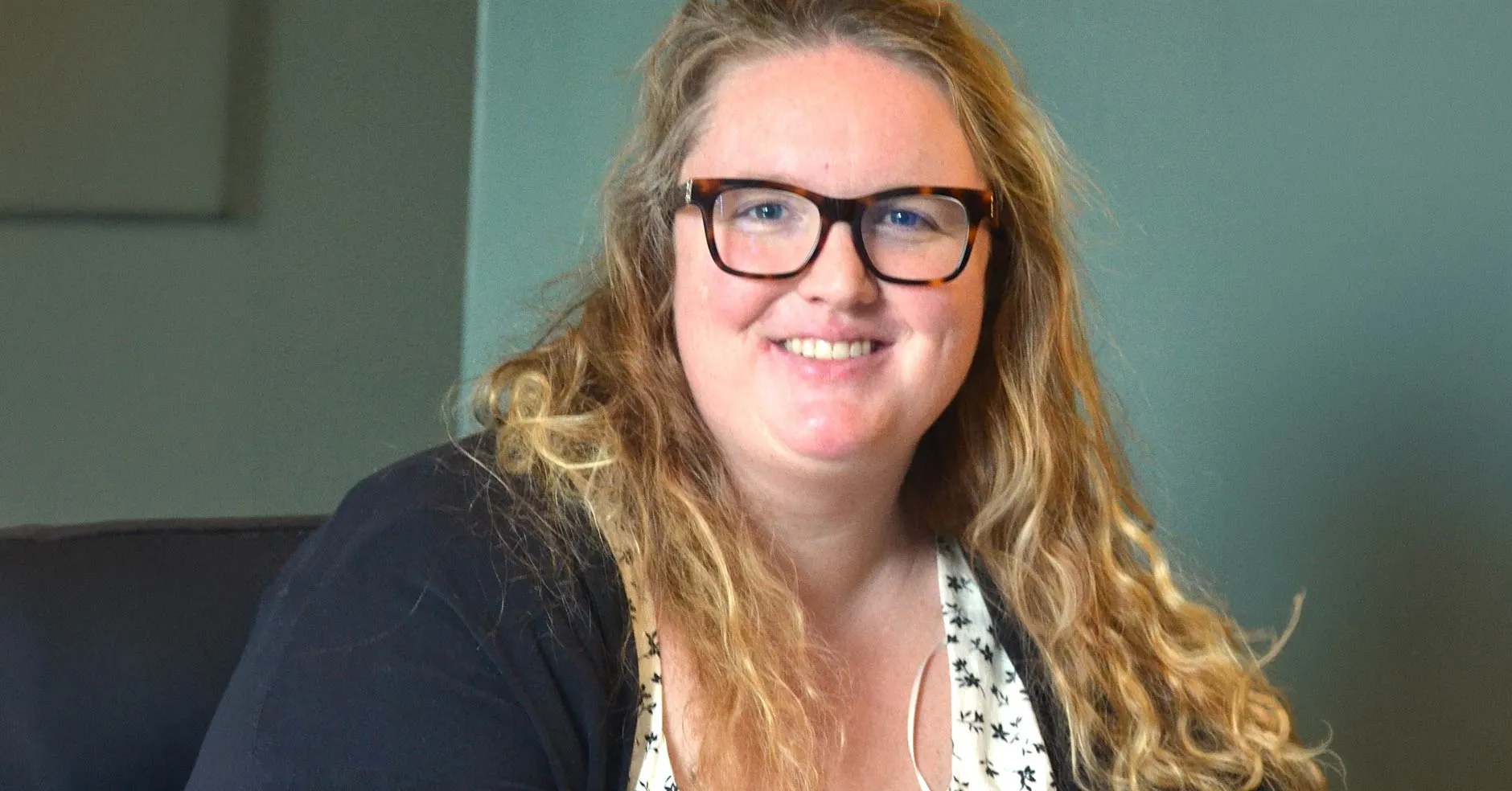
Kentucky native Rebecca Douglass, DO, jumped at the chance to return home to provide surgical care at Saint Joseph Health
LEXINGTON When Saint Joseph Hospital came calling in November 2024, Rebecca Douglass, DO, general surgeon, says, “I ran as fast as I could back home. If they would have let me sign a contract over the phone, I would have.”
A native of Frankfort, Douglass graduated from the University of Kentucky before obtaining her medical degree at the UK College of Osteopathic Medicine in Pikeville. After her studies in Kentucky, Douglass completed her surgical residency at Metro Health University of Michigan Health in Wyoming, Michigan, before accepting her first job with Newman Regional Health in Emporia, Kansas. There she performed general surgery, endoscopy, and wound care, but mostly focused on breast surgery and endoscopy.
Douglass knew from an early age she wanted to be a surgeon. She witnessed her first surgery, a cardiac procedure where she could actually see the beating heart, while volunteering at Saint Joseph Hospital, part of CommonSpirit Health. She immediately knew she wanted to be a surgeon because surgery combines working with her hands and building things, two of her passions. Her grandmother, a nurse, also had an influence on her early desire to work in medicine. Douglass credits her grandmother with teaching her how to take care of patients. “She was my role model and mentor in terms of wanting a career in medicine,” Douglass says.
Kentucky has a disproportionate number of patients with heart disease, cancer, and obesity. Douglass sees higher representation of patients with those comorbidities at Saint Joseph Hospital because it is a tertiary transfer center. “I would say that Saint Joseph sees the sickest of the sick. We get a lot of patients with cardiovascular disease that end up needing surgery like bowel surgery, their gallbladder, or different things,” she says.
Rural counties in Central Kentucky have community hospitals, but they can’t always handle complicated cases that require more advanced technology or specialists. Many of Douglass’ patients are from Lexington, but a good number are referrals from those smaller facilities in Eastern Kentucky.
Douglass wanted a job in a hospital where she could care for patients who needed acute care and have complex emergent needs but also perform elective surgeries like hernia repairs and panniculectomy, the removal of excess skin after weight loss.
“I thought Saint Joseph could give me a good mix of those versus a smaller facility where I would be doing mostly elective surgery,” she says.
For Douglass, the appeal of being a surgeon is that she gets to see adult patients of all ages and sometimes gets to provide patients an immediate fix. “Patients come in and have pain because of their gallbladder, bowel perforation, and other ailments. I like that I could do surgery and they felt better immediately,” Douglass says.
The da Vinci 5 at Saint Joseph Hospital
Douglass performs the majority of her surgeries with minimally invasive techniques, using the new da Vinci 5 robotic surgical system, newly acquired at Saint Joseph. At 37 years old, Douglass is among the younger generation of physicians, who have used robotic and laparoscopic instruments since they began training. Still, Douglass has seen iterations of four different robotic systems since she began her medical training. She considers herself fortunate that she is able to use the da Vinci 5 as often as she does.
The da Vinci 5 provides haptic feedback, which allows the surgeon to feel what they are doing inside the body. “If I’m doing open or laparoscopic surgery, I can feel the tension when I’m pulling on something. Previously in robotic surgery, we couldn’t feel that. One of the concerns surgeons had with the earlier versions of the robot was that it could pull too hard on something, and you couldn’t tell, because you didn’t know the strength being used. You learned the strength over time by performing cases, by seeing how the tissue reacts, versus feeling it. There’s a huge advantage now that we can feel that degree of feedback. Research has shown decreased potential injuries because of that,” says Douglass.
The da Vinci 5 incorporates artificial intelligence, which allows it to analyze how a surgeon performs surgery and provides feedback on how to improve the surgery. This can lead to better efficiency and shorter operative times.
Douglass explains, “It looks at exactly how I’m doing something, and even though I’m doing something safe, maybe this is something I can improve upon the next time. That removes a lot of the guessing game on how to improve. The da Vinci robots have been watching surgeons over time, and they have learned how we can do this better. It takes away the fact that I need to figure out what I’m not doing right or could do better and now this machine tells me how I actually can be more efficient or perform this maneuver better.”
Douglass looks forward to further innovations in technology like cameras that can provide new views of the body, development of smaller ports sites, and new instruments. “Saint Joseph is committed to having the next advancement. The facility here is very dedicated to advancing care. I’ve always found Saint Joseph to be innovative and progressive in my 10-plus years of doing this.”
The Importance of Clinical Coordination
Collaboration is high on the list of things Douglass appreciates about Saint Joseph and CommonSpirit. Physicians facilitate a collegial environment in which they are constantly communicating to advance care for their patients. Saint Joseph’s extended network in surrounding counties aids patient treatment because a patient can travel to Saint Joseph in Lexington to undergo a surgical procedure, but then transfer back to a facility that’s closer to home within the CommonSpirit Health network for aftercare.
Douglass recalls discovering esophageal cancer in a patient and coordinating testing, intervention, and treatment for that patient within a week of their symptoms starting. She credits the timeliness of advancing treatment to the open communication network she shares with her fellow physicians. Instead of just placing an order for a patient to be scheduled for consultation after finding the cancer, she and her oncologic colleagues were able to coordinate care for that patient in a timely manner that benefited that patient.
“Taking the ten extra minutes to call the other physicians who can help benefit your patient can really make a huge outcome in someone’s life,” she says.
A Busy Schedule and Family Time
Douglass’ busy schedule includes a day and a half to two days of clinical work, two days of surgery, and a day of administrative work or add-on cases. In addition, she takes approximately 12-16 days of call, rotating between Saint Joseph Hospital and Saint Joseph East, both in Lexington. “The surgeon’s job is 24-7. It’s not really scheduled,” she says.
In addition to managing work at two hospitals among other clinical duties, Douglass is the mother of two young children, ages five and three. Saint Joseph provides her autonomy over her schedule, so on a light day or when she’s caught up, she gets to pick up the kids from school and spend extra time with her family.
Douglass understands the importance of being a woman in the surgical field. In Kansas, she was the only female endoscopist and surgeon within an hour and a half of her hospital. Many female patients choose her because she is a woman. Being a provider that her patients could feel comfortable with, in one of the scariest times in their lives, was important to Douglass.
Approximately 30% of surgeons are females. Since some female patients prefer to have female doctors, she encourages women to consider the surgical field.
“You know, you can do it. Having children and a family, it’s hard and there are sacrifices you have to make, but just because you’re a woman doesn’t mean you can’t become the chief of general surgery at a large tertiary hospital in your hometown that you love.”