
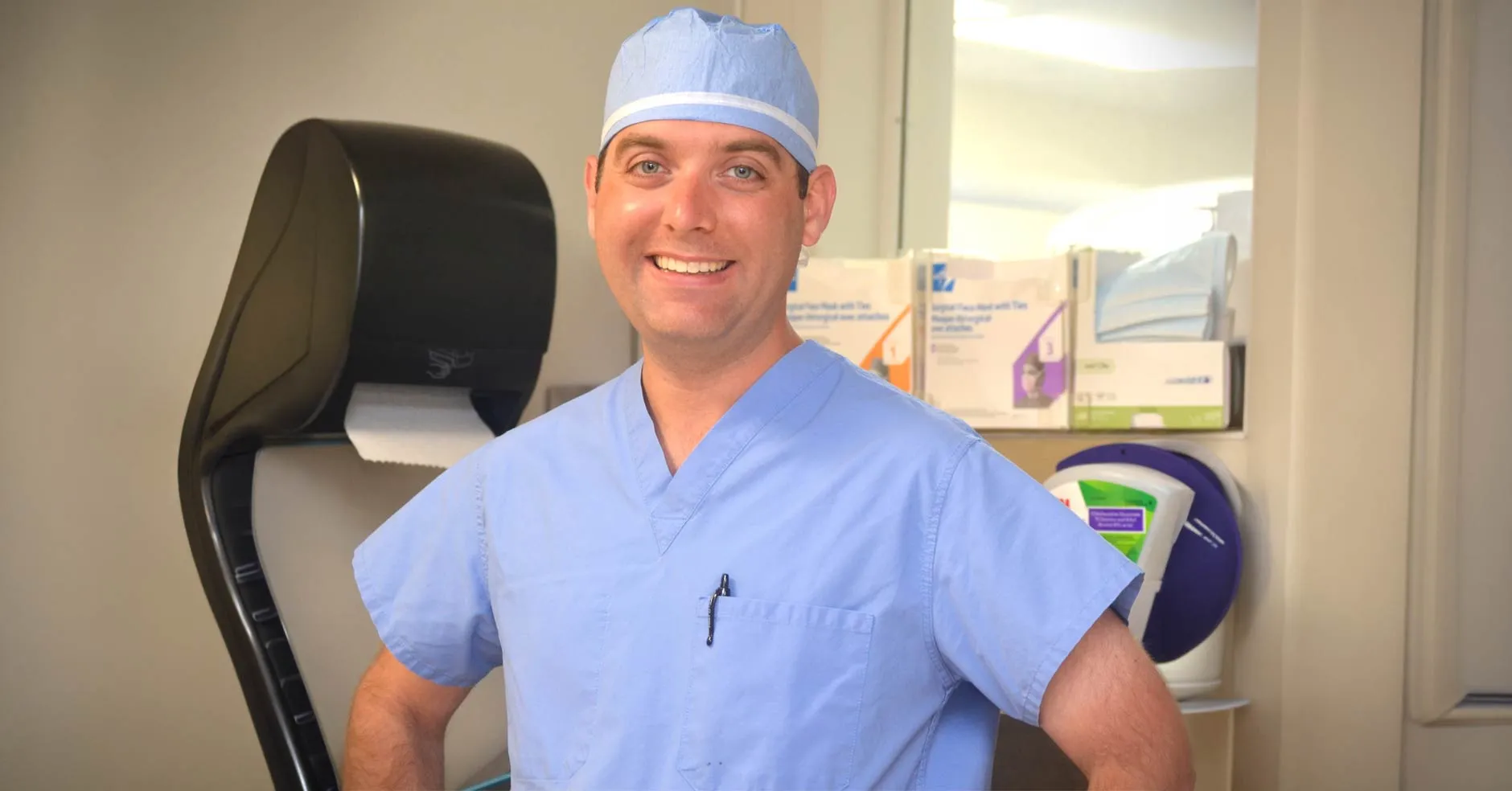
Early detection can help stem rising tide of colorectal cancers in the under 50 age group
LOUISVILLE In his 20s, Sam Walling, MD, knew he was going to be a doctor and knew he was going to work for Baptist Health.
What he didn’t know was mere years after taking a position at Baptist Health, patients that same age would come to him for help with rectal cancers, a disturbing trend taking shape across the country.
“We used to think of colon and rectal cancer as a disease that affected people in their 60s, 70s and 80s, and then the early ones were in their 50s,” he says. “But now we see patients that are in their 20s, 30s, and 40s that have rectal cancers. Very frequently, I have patients that are less than 50 years old.”
Walling, a colon and rectal surgeon with Baptist Health, says the cause for the surge in those cancers in patients so young is still not completely understood.
“It has to be some kind of environmental factor, because it’s happening more in the western, more developed countries,” he says. “We don’t know if it’s the processed foods in our diets, our more sedentary lifestyles compared to 50 years ago, or some kind of environmental exposures. We don’t know if it’s any one thing in particular. Most likely the source is multi-factorial that’s happening predominantly in more industrialized, Westernized countries.”
While Walling’s practice focuses on all aspects of colon and rectal surgery, cancer in younger patients continues to be a disturbing trend.
Always Going to Be a Physician
Walling grew up knowing he wanted to be in medicine, and that he wanted it to be at Baptist Health. Born and raised in Louisville, Walling volunteered at the hospital and got a taste of what being a doctor was like. During high school and college, he worked within the sports medicine programs at Saint Xavier High School in Louisville, and later in college.
“I knew in the fifth or sixth grade that this was what I was going to be,” he says. “Every summer, I got a taste of a different area. I always thought that it would be a really fulfilling career, and that was what attracted me, especially the procedural disciplines. I was always hanging around physicians and healthcare workers in that setting. I think when you’re around people that you admire, you want to be like them.”
Walling graduated from Vanderbilt University with his bachelor’s degree in bio-medical engineering, then came back to the University of Louisville School of Medicine for his medical degree. After a residency in general surgery and a colon and rectal surgery fellowship at the University of Kentucky, he returned to Louisville to work at Baptist Health.
During his medical education, he reached out to Richard Pokorny, MD, a general surgeon at Baptist Health. Years before, while Walling was a first-year medical student, Pokorny had taken care of his grandfather. As the two talked, Pokorny told Walling to call him when it came time for his rotations.
“So, two years later, I cold-called him, and said, ‘Hey, we met two years ago, and you said if I wanted to do this, and if it’s still on the table, I’d love to,'” Walling says. “He said yes, so, I worked with him for a month, and then I came back for another month. That turned into conversations of a job, and by my third year of residency, I had already signed a contract with Baptist Health, with three years of training to go. It was just always where I was going, and the team here made it happen.”
Working in different healthcare settings throughout Louisville helped him decide that Baptist Health was the place for him.
“I’ve worked at every hospital in the city of Louisville in some capacity, whether it was a student or a volunteer or whatnot, and I always felt that Baptist Health just had a different feel,” he says. “It is very much a team effort between the nurses, the physicians and the rest of the staff to provide the best care we can to every patient.”
A Younger Age for Colonoscopies
Within his practice, Walling has been keen to understand what is happening with the increasing incidence of colon and rectal cancer in younger patients. According to the American Cancer Society, colorectal cancer rates are rising by 3 percent annually in adults under 50, making it the leading cause of cancer death in adults in that age group. While colorectal cancers are declining in older adults, nearly half of all new cases now happen in patients under 65. About three out of four adults under 50 with colorectal cancer are diagnosed when the disease is at an advanced stage.
The response to that has been to lower the age for colonoscopies down from 50 to 45, Walling says, even sooner if there is a family history of the disease or colon polyps.
One of the unfortunate aspects of colon and rectal ailments, he says, is the stigma around discussing issues that have to do with that area of the body. The issues they’re having may be a difficult subject to talk about, which can delay treatment and discovery.
“I think one of the most important things for me is to develop a rapport with my patients and show them that I have a little bit of a sense of humor about what I do. We’re going to talk about some personal stuff, and it’s okay,” he says. “If they don’t feel at ease to be honest about some of the issues that they’re having, then I’ll never get to the bottom of what they actually have going on.”
The responses he gets from patients vary too.
“You walk in, and some people are sitting in the corner, and they’ve strapped their belt three loops tighter, like, ‘You’re not getting to me,'” he says. “Then you walk in with some people, and you’re thinking ‘Will you please put your clothes on and stop showing me your butt?’ You have to meet them where they are and get them to a point of comfort so that you can have really honest conversations about all this stuff.”
Robotics and Detection
While the incidence of colorectal cancer may be on the rise, the treatments at Walling and his team’s disposal are improving with new surgical techniques, more effective medical treatments, and even approaches that can avoid surgery altogether. With these strides in multimodal treatment, patients are experiencing better treatment response with fewer side effects and improved quality of life. Some offices, like his, have opted to include robotics into the treatment option mix as well.
“I do whatever I feel is the best for the patient, and usually that means the best operation I can give them, technically, in the shortest amount of time under anesthesia,” he says.
Better treatments and earlier detection, Walling says, are keys to decreasing the disease’s fatality. While the incidence of colorectal cancer has increased, he says, so has the survival rate.
But that all starts, he says, with getting people over the stigma of colonoscopies.
“We can save someone from this disease, and it can cause a domino effect. We know that there is a genetic predisposition to the disease,” he says. “If we can get one person screened and that screen catches something, then we can save a whole family and possibly generations to come. It’s one day out of your life hopefully every 10 years, but it can change the course of your life and the lives of your family for the better.”