Q & A with Mark Esterle, MD, Baptist Health Louisville & Louisville Pulmonary Care on performing 1,000 Ion robotic-assisted bronchoscopies.
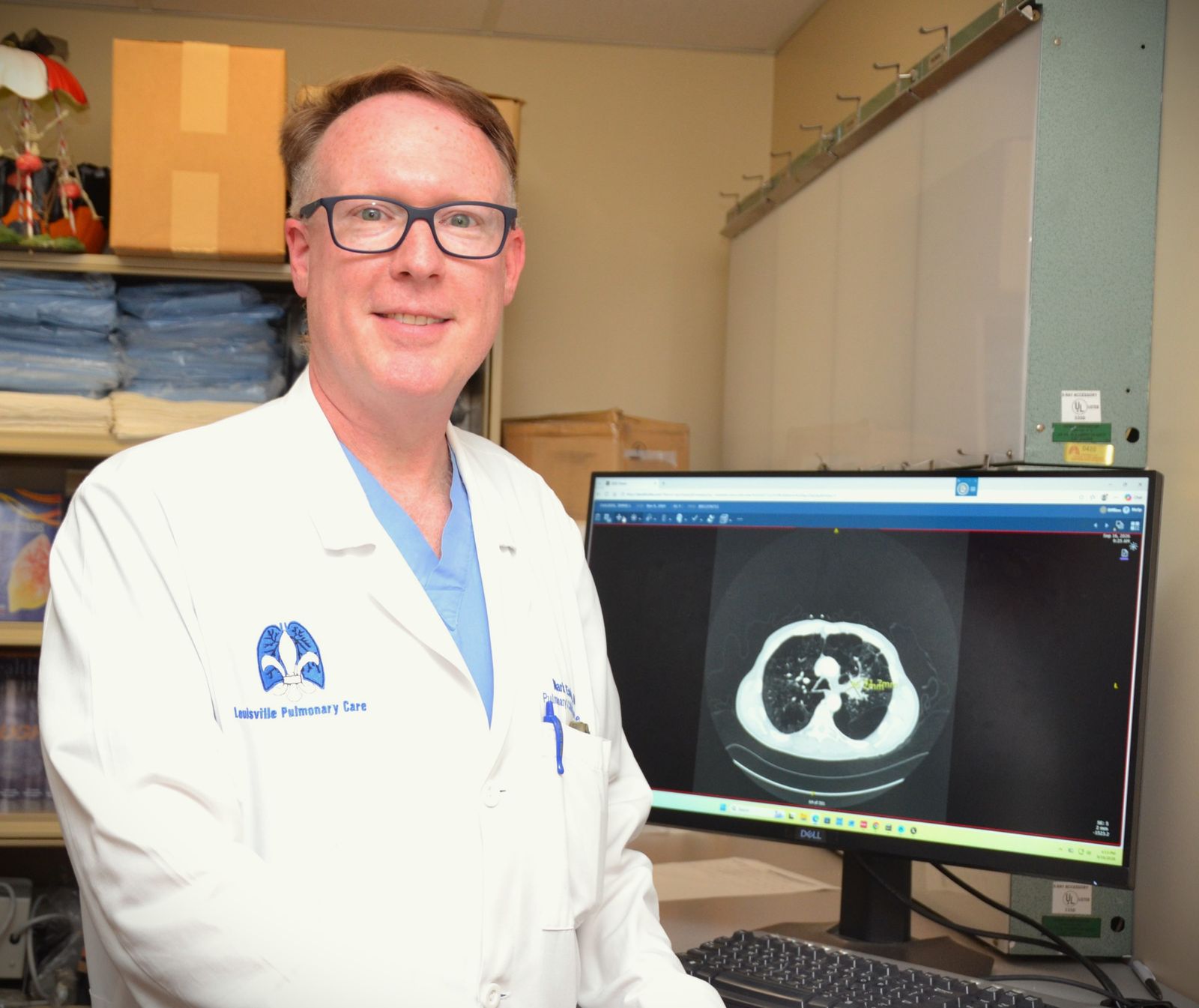
EDITOR’S INTRO: Mark Esterle, MD, is a home-grown Louisville native, a graduate of Saint Xavier High School, the University of Louisville and the UofL School of Medicine with a fellowship at the UofL Brown Cancer Center. He is a member of Louisville Pulmonary Care, a group of twelve partners, and is closely affiliated with Baptist Health Louisville and La Grange. He is a critical care specialist and pulmonary interventionalist; a part-time, left-handed drummer and percussionist. He comes from a musical family and had a scholarship offer to the renowned Berklee College of Music in Boston. At UofL, he had a fraternity brother with cystic fibrosis which introduced him to pulmonary disease and remains a touchstone for him.
MDU: What is the benefit to other doctors of Baptist Health Louisville being an Ion National Case Observation Site?
Becoming an Ion National Case Observation Site is an exciting opportunity because the benefit extends well beyond our own program. It allows us to share what we have learned with physicians from across the country who are developing or expanding their own robotic bronchoscopy programs.
For other physicians, there is tremendous value in being able to see the procedure performed in a real clinical environment—not just through a lecture or a video. They can see how we select patients; how we plan cases; how we use the technology; how we work with anesthesia and the endoscopy team; and how we manage the procedure from start to finish. Just as importantly, they can see the decision-making that goes into challenging cases. We have now performed more than 1,000 robotic bronchoscopies at Baptist Health, so we have accumulated a significant amount of experience that we can share with other physicians.
MDU: What’s the benefit to patients?
For patients, the ultimate benefit is that education translates into better access to advanced diagnostic capabilities. As more physicians become comfortable using robotic bronchoscopy, more patients with small or difficult-to-reach pulmonary nodules can potentially be evaluated locally and diagnosed earlier, rather than having to undergo a more invasive procedure.
MDU: What’s the benefit to Baptist Health Louisville?
For Baptist Health Louisville, becoming a National Case Observation Site places the institution on a national stage for something that has become a real strength of the organization. It demonstrates that Baptist is not only adopting advanced technology, but developing the expertise and infrastructure to use it at a very high level and to teach others how to use it effectively. We are one of approximately 35 observation sites nationally, and one of only three places in the entire country that uses this technology in a in a flip-room model, which dramatically increases the number of cases we can do in a day.
MDU: How will this designation move your program and your work forward?
This moves the program forward by forcing us to continually evaluate what we are doing and how we can do it better. When you have physicians coming from other parts of the country to observe your cases, you have a responsibility to be thoughtful about your techniques, your outcomes, your patient selection, and your entire workflow. Teaching others ultimately makes you a better physician.
And there is a larger opportunity here. We have gone from learning how to use the technology ourselves to now helping other programs develop their own expertise. If we can share what we have learned and help raise the quality and consistency of robotic bronchoscopy nationally, then the impact goes far beyond the walls of Baptist. Ultimately, that means more patients with lung nodules can have access to precise diagnosis and, when appropriate, earlier treatment.
MDU: Who is the optimal patient for the Ion robotic-assisted biopsy system? Who is not a good patient?
The ideal patient for Ion is someone with a suspicious lung nodule that needs a tissue diagnosis—particularly a small, peripheral, or difficult-to-reach lesion. That’s where robotic bronchoscopy can really make a difference. It allows us to navigate deep into the lung and obtain tissue from lesions that can be challenging to reach with conventional bronchoscopy.
It also involves the entire cancer journey. When appropriate, we can potentially obtain tissue and perform staging during the same procedure, helping move a patient more efficiently from an abnormal CT to a diagnosis and treatment plan.
But Ion isn’t the right answer for every patient. If a lesion is easily accessible by another approach, or if a CT-guided or surgical biopsy offers a better option, we should use that approach. Patients who can’t safely tolerate bronchoscopy or anesthesia may not be candidates.
I don’t see Ion as replacing other biopsy techniques. It’s another tool that has expanded what we can offer—particularly for small, peripheral, and challenging lung lesions.
Ultimately, the question isn’t “Can we use Ion?” It’s “What is the best and safest way to get this patient the diagnosis they need?”
MDU: Describe your patient population by age, gender, presentation. Are there trends in the lung cancer patient population?
My patient population is predominantly adults in their 50s through 80s, with both men and women, and I see a broad spectrum of patients—from higher-risk current or former smokers identified through screening to patients who present with an incidental pulmonary nodule on imaging.
One trend I’ve noticed is that we’re seeing more patients with smaller, earlier-stage nodules, often found incidentally or through CT screening. We’re also seeing lung cancer in patients who have little or no smoking history, particularly women, which means we can’t simply equate lung cancer risk with smoking history anymore. Nationally, about 10–20% of lung cancers occur in never-smokers, and that population is disproportionately represented by adenocarcinoma.
That changing population is one reason that technologies like robotic bronchoscopy are increasingly important—because we’re being asked to diagnose smaller and more peripheral lesions in a much broader patient population.
Tobacco smoking was the plague of the 20th century. Younger people have stopped smoking as much, but have taken up vaping instead.
MDU: What outcomes have you seen as a result of the Ion robotic-assisted biopsy system?
The biggest outcome we’ve seen is that Ion has expanded what we’re able to diagnose. We can pursue smaller, more peripheral, and more challenging nodules, some less than six millimeters in size, that historically were difficult to reach and we can get a definitive diagnosis sooner and potentially avoid a more invasive biopsy. Baptist acquired the Intuitive ion robotic-assisted platform in 2024. Since then, with more than 1,000 cases, we’ve also become more efficient and confident in managing increasingly challenging lesions. The ultra-thin catheter uses fiber optic shape sensing instead of electromagnetic navigation and is so much more precise and accurate than what we were using before. This isn’t horseshoes, where close is good enough. Our tissue yield using the robot is 93–94%, when it used to be around 30%.
Ultimately, the outcomes that matter are diagnostic yield, safety, and time to diagnosis—and, most importantly, getting patients to the right treatment sooner.
MDU: What is your motivation, what’s your “why” for being a critical care and pulmonology specialist at Baptist Health Louisville?
My “why” is simple: It’s the patients and the opportunity to make a difference when it matters most. Critical care allows me to care for patients at their sickest, while pulmonary medicine allows me to build relationships with them over time. I love that combination.
At Baptist, I’ve also had the opportunity to build and advance programs and bring new capabilities to our community. What motivates me is continually asking, “How can we do this better for our patients?”
Ultimately, I want to provide exceptional care close to home and leave our program better than I found it.
MDU: How can other physicians contact you about observing an Ion robotic-assisted bronchoscopy?
My email is mesterle@lpcdocs.com. At Baptist Health Louisville my phone number is 502.899.7377. I encourage primary care doctors, pulmonologists, and radiologists to reach out to us.