New medication-based treatment promises effective treatment for pancreatic cancer
LEXINGTON — Working to test the efficacy of a new pancreatic cancer treatment in pill form is one of the joys for Rayli Pichardo, MD.
Working at the University of Kentucky’s Markey Cancer Center, Pichardo is part of a team studying the efficacy of Rasonque, a new treatment for late-stage pancreatic cancer that comes in pill format. Being able to find a new way to treat cancer and help patients is part of what made her want to be a doctor.
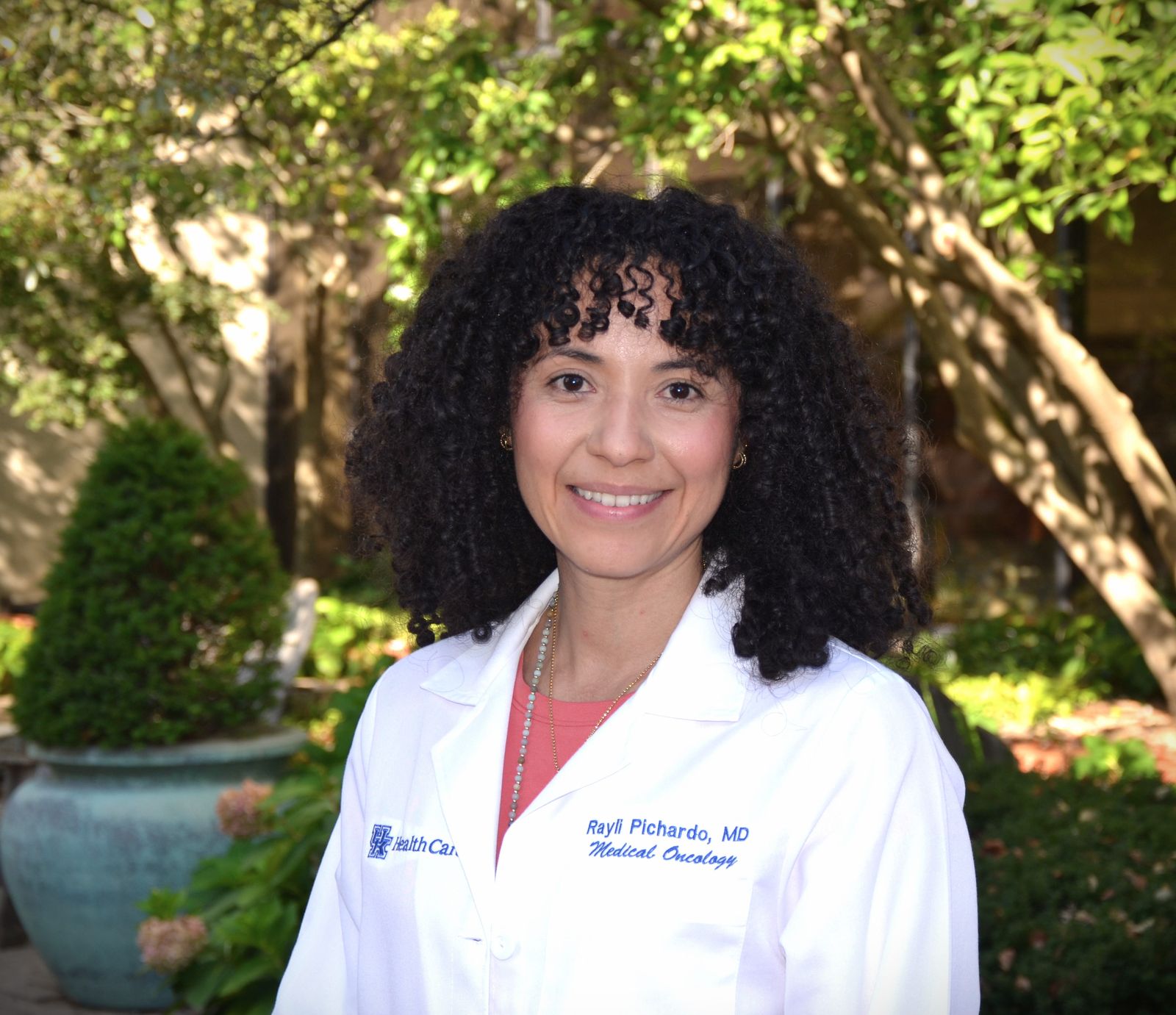
Born in Valencia, Venezuela, Pichardo earned her medical degree from the University of Carabobo in Venezuela, then came to the United States to complete her training. She finished her internal medicine residency at the John H. Stroger, Jr. Hospital of Cook County in Chicago, then went on to do a palliative and hospice care fellowship at the MD Anderson Cancer Center in Houston, and a hematology and oncology fellowship at the Henry Ford Hospital in Detroit.
She came to America to get the best in medical education, she says.
“It’s definitely a different level of education and access to new treatments, to new devices, better ways to treat patients… especially in oncology, where it’s changing constantly. You really want to have access to that and being able to offer the better treatments and continuously grow in that field,” she says.
Fueled by a desire to make a difference, she looked to her aunt, a neurosurgeon, and her father, as inspiration. In her teen years, she was asked to make a decision as to what career field she wanted to go into. She says she knew she wanted to be in medicine.
“I wanted to be in healthcare because I like talking to patients,” she says. “I was undecided between psychology and medicine. You don’t have a lot of options in Venezuela. My mother bought me the stethoscope, and that was it.”
Her drive to go into oncology was started by the death of her father.
“I think I would have been happy with working in so many different fields, but oncology is a field where you can really make an impact in patients’ lives and be there for patients,” she says. “My dad was diagnosed with a high-grade lymphoma when I was 18. It was actually a recurrence. He had lymphoma when he was very young, and he went through very aggressive chemotherapy. He had a bone marrow transplant, and then, unfortunately, his cancer progressed, and he did pass away when I was very young. That changed my outlook in life — understanding that the importance of having a doctor you trust and is able to go through that journey with you, valuing who you are as a person and as a family.”
UK’s Markey Cancer Center: Collaboration. Clinical Trials. Treatment.
Pichardo is now an oncologist specializing in breast and gastrointestinal cancers. She came to UK to continue her work in the field.
“The fact that the Markey Center is an NCI-designated comprehensive cancer center really provides those tools to be able to not only have access to experts in the field, but be able to share your knowledge with other teams,” she says. “We have a great research team, and so I’ve been able to be a part of clinical trials, early research, and teaching the new generations of fellows and doctors.”
Which has led to her use of Rasonque as advanced pancreatic cancer treatment. Presented in June at a conference for the American Society of Clinical Oncologists, the drug showed impressive results, she says, doubling the rate of survival amongst patients using it.
“Right now, it’s approved as second line, meaning patients who have stage four cancer, metastatic cancer that is not curable, after they receive chemotherapy and they progress, or if they’re not eligible for that chemotherapy, then they can start this therapy,” she says.
The medication has seen some success on the few patients she and her colleagues have used it with. Now approved by the FDA, the pill is ready for physicians to prescribe it to their patients. It’s a medication that patients are already aware of, she says.
“Even back in April, before it was presented at the conference… everyone kind of knew what it was going to show, just not exactly the numbers,” she says. “The patients were already coming with the generic name Daraxonrasib on a little piece of paper asking, ‘Can I get this pill?’ It wasn’t only the medical community; it was the pancreatic cancer patients because they tend to be very educated and very motivated because it’s such a heartbreaking disease.”
There are other medications coming as a result of Rasonque’s success, she says.
“What this pill did was open a new door of targeted treatments because it’s a unique mechanism of action as an RAS inhibitor, which historically was thought to be a non-targetable molecule,” she says. “We didn’t think there would be a drug that could ever target that mutation. Now that we know it’s possible, we have multiple molecules that are targeting that pathway. I think we’re hoping that new medicines come with similar action, but maybe more effective.”
Pancreatic Cancer Is Difficult to Diagnose Early
Pichardo says there may be a medication that can be adapted to ensure the cancer will not come back, and possibly medications that can be used in conjunction with chemotherapy in patients who can’t have surgery.
But primarily, she says, it’s important to catch pancreatic cancer early so treatments can be effective. Pancreatic cancer is one of the most difficult because patients don’t necessarily detect it early enough. Without pain endings in the pancreas, it’s hard to initially detect. And as the cancer progresses enough for patients to notice their jaundice, the cancer has progressed too much.
“When people start noticing symptoms, it’s usually because the cancer has progressed so much that we are getting jaundice, because their bile duct is obstructed or the tumor is so big that it’s pressing on the nerves and that’s causing pain,” she says. “By that time, it’s too late to do surgery, because surgery is really the best way we have to cure most cancers.”
Pancreatic cancer also tends to be treatment resistant, she says. Daraxonrasib is one of the first new treatments to help pancreatic cancer patients in decades, she says.
And helping patients — whether it be with pills, chemotherapy or surgery — is one of the parts of her job that she loves.
“Cancer is not a disease; it is part of a person’s journey,” she says. “I wanted to be that for my patients and be able to train well enough to feel confident that I’m really helping them make the best decisions for what is their priority.”
UK Markey Cancer Center’s Multidisciplinary High-Risk GI Clinic
LEXINGTON — The Multidisciplinary Clinic at UK’s Markey Cancer Center treats all GI cancers and more, including stomach, gallbladder, pancreas, liver, appendix, anal, genitourinary, melanoma, mesothelioma, musculoskeletal, neuroendocrine, penile, prostate, sarcoma, and testicular cancer.
The high-risk GI clinic was started in 2020 by Tamara Carey, APRN, in alignment with Markey’s team of genetic counselors. Carey is one of 47 providers.
The adjacent chart shows volumes for patient visits by both new patients and office visits, which are the established patients.
| Year | New Pt. | Office Visit | Total |
|---|---|---|---|
| 2021 | 66 | 217 | 283 |
| 2022 | 114 | 638 | 752 |
| 2023 | 106 | 712 | 818 |
| 2024 | 138 | 1652 | 1790 |
| 2025 | 241 | 2627 | 2868 |
| 2026 | 175 | 2528 | 2703 |
| Total | 840 | 8374 | 9214 |
“A high prevalence of Lynch syndrome, ATM, and BRCA mutations among the Eastern Kentucky population increases the risk of developing multiple cancers with some patients being very young. There’s also a high prevalence of pancreatic, liver, biliary, and gastric cancers in patients from the areas of coal mining and heavy industrial areas. Additionally, high numbers of patients with obesity, diabetes, and tobacco abuse cause health-related issues,” says Carey.