
Using new delivery methods for levodopa may help with symptoms of Parkinson’s disease, but fighting biases against using the drug early is a first step in treatment.
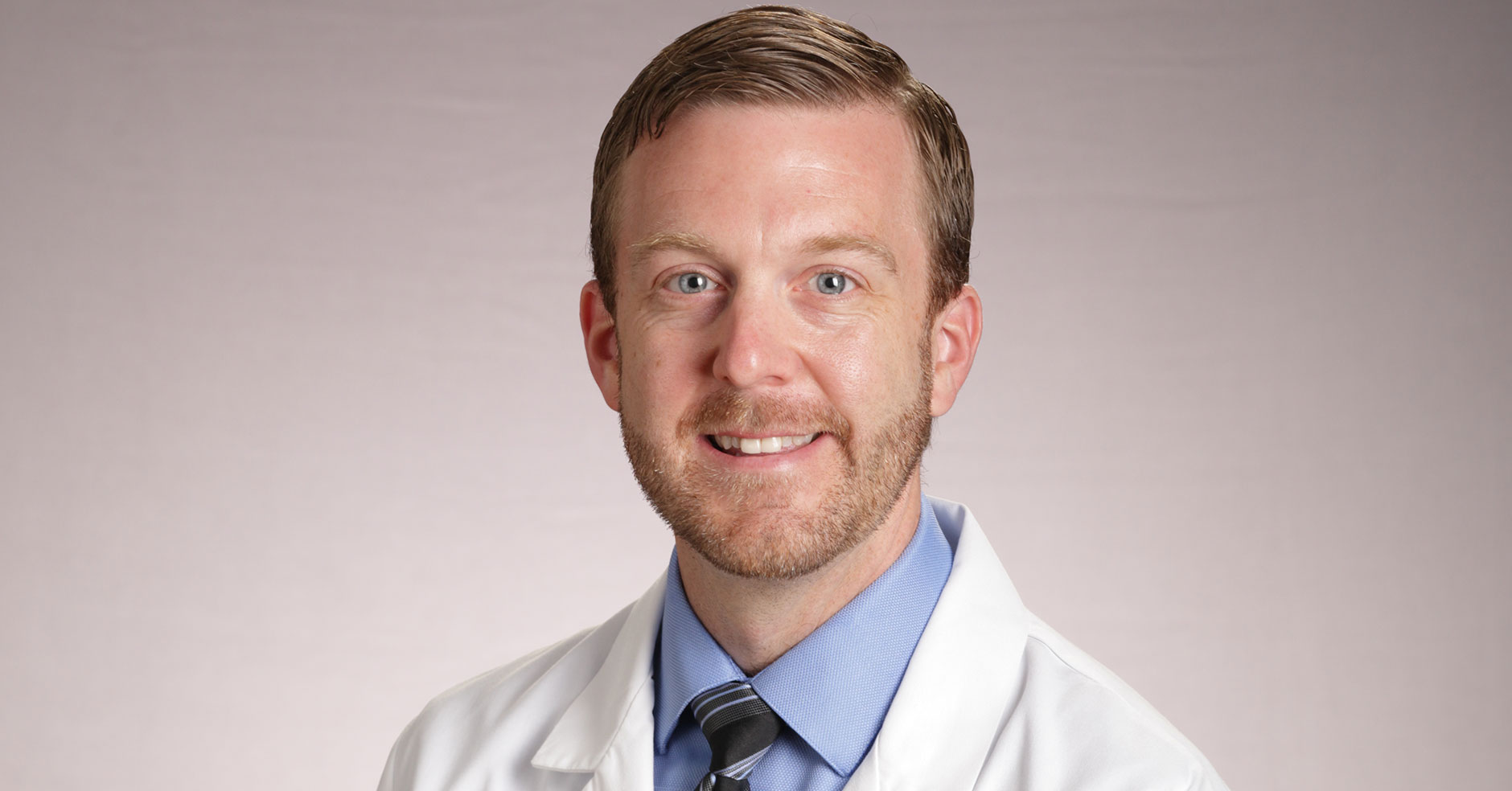
LOUISVILLE Justin Phillips, MD, medical director of movement disorders at the Norton Neuroscience Institute in Louisville, says the use of a subcutaneous pump can help regulate the flow of levodopa for patients and address their motor symptoms more effectively. Although there are some misconceptions, even in the medical community, that patients can develop an immunity to levodopa, Phillips says it continues to be the most effective treatment for motor symptoms in Parkinson’s disease, and the subcutaneous pump can help address fluctuations in the drug’s effectiveness.
Phillips, who grew up in Danville, Kentucky, understands the impact of movement disorders. While he says it didn’t influence his decision to go into neurology, he has a family history of essential tremor. Phillips himself, his father, his grandfather, and his great-grandfather all have been diagnosed with essential tremor. When his best friend’s sister was diagnosed with myasthenia gravis, he developed an interest in autoimmune neurology. Ultimately, however, he decided to pursue movement disorders.
Phillips received his undergraduate degree from Centre College in psychobiology and philosophy before attending the University of Louisville School of Medicine. He did his internship in internal medicine and a residency in neurology at UofL, then a fellowship in movement disorders at the University of Kentucky College of Medicine.
“When I was heading to medical school, I was planning on being a general practitioner, maybe even going back to a small town like my hometown,” he says. “But as I got into medical school, I discovered a real interest in
neurosciences, which is what I had majored in and had interest in as an undergraduate.”
Phillips says he was not exposed to specialists in his hometown and that once he realized there were physicians who specialized on the brain, the nervous system, or other parts of the body, it dawned on him that he could focus his career where his passions lie.
“Once I got into medical school and started those courses, I was drawn into the neurosciences again and decided that’s where I wanted to focus,” he says.
When Phillips started working in the field, he found that he had a passion for working with geriatric patients, particularly those with tremors and Parkinson’s disease. After working at Norton Healthcare for a decade, Phillips says as sub-specialist in movement disorders, he sees patients with everything from dystonia to Huntington’s disease, to essential tremor like his own. Nearly 75 percent of his patient base has Parkinson’s disease. “On average, those patients tend to be in the 60s and older, although we have diagnosed patients as young as in their 20s at Norton,” he says. “Other than Parkinson’s disease, I would say the bulk of patients are probably essential tremor, and those are fairly even male to female. Their age can vary, but they tend to still be older, at least in their 50s.”
Phillips says while Parkinson’s is a movement disorder, not all movement disorders are Parkinson’s disease.
“The term ‘movement disorder’ generally is reserved for disorders that affect the basal ganglia part of the brain and the part of the brain called the cerebellum,” he says. “Parkinson’s disease is really the primary diagnosis. That’s what we call a hypokinetic movement disorder, meaning, rather than extra movements, patients with Parkinson’s disease have a lack of movement or a difficulty initiating movement. And so, it is really the primary hypokinetic movement disorder.”
One of the most effective treatments of the disease is the administration of levodopa, he says. But some physicians hesitate to use it too soon after a diagnosis.
“Unfortunately, there’s some fear about starting medications for Parkinson’s, particularly levodopa. Some of that persists in the medical community, particularly physicians who trained years prior to now. There was some belief that if you started medication on the patient too soon, they could essentially become immune to it, or that it would cause progression of the disease faster. So, the previous approach was that you shouldn’t start the medicine on your patient until it was absolutely necessary to,” he says.
But the current science just doesn’t support that, he says. There is no disease modification of starting the medicine early, and no virtue in waiting to start using it.
“It doesn’t slow down progression of the disease, so it’s neither important to start early, nor is it important to delay start,” he says. “The time to start medication for Parkinson’s disease is when the patient is bothered enough by their symptoms to start the medication, knowing that the symptoms may become more disabling. Interventional types of treatments are reserved for more advanced disease.”
Meet Jason Crowell, MD
Jason Crowell, MD, a neurologist and movement disorders specialist at Norton Neuroscience Institute who works with Phillips, says getting patients on medication can dramatically impact their quality of life.
“It is not rare for people to eventually get on the right dose of a Parkinson’s medicine and then say that it had a had a dramatic effect in their quality of life, because oftentimes the symptoms of Parkinson’s are so slow that people can live with this for months or even years without being aware of a diagnosis,” he says. “By the time that you get them on the right treatment, they benefit so much that it can be dramatically helpful.”
Crowell received his MD from the University of Alabama School of Medicine, then completed his residency in neurology at the University of Virginia and did fellowship training in movement disorders at the University of Alabama-Birmingham. He was also a Grossman Graduate Fellow in Healthcare Policy at Harvard’s Kennedy School, where he received a master’s degree in public administration. Crowell was named a Fellow of the American Academy of Neurology (FAAN) in 2025, signifying a high level of expertise and contribution to the field of neurology.
Growing up, Crowell says he thought he was going to be a surgeon, but in medical school his first rotation was in neurology, and he fell in love with the power of the neurological exam.
“I thought it was really cool that doctors could walk in a room and make a diagnosis by
just examining patients and getting so much information, whereas so many other specialties require all sorts of tests,” he says. “I wasn’t sure if it was just because it was my first rotation and I was just excited to be in the clinic, or if it was actually specific to neurology. As I rotated through other specialties, I realized this was really the fit for me.”
At the same time, his grandfather, a smalltown physician in Crowell’s hometown in Florence, Alabama, developed Parkinson’s disease-related dementia. His interest in neurology grew as he saw how the disease affected his grandfather.
He says he was attracted to Norton Neuroscience Institute because the position allowed him to be a sub-specialist in movement disorders.
“I wasn’t interested in being a general neurologist. I felt like that wasn’t my skill set, trying to see patients with all different types of diagnoses,” he says. “I really wanted to focus in on this area with neurology. Here, I’m able to just do movement disorders, patients with Parkinson’s and tremor and these types of diagnoses.”
Crowell says for Parkinson’s patients, the medication must sometimes be tweaked to get to the right dosage.
“We know the medicines that can help the symptoms of Parkinson’s, but I can’t predict the dose. Finding the right dose is variable from person to person, and certainly their response to it is variable,” he says. “It takes some trial and error, because there’s no way to predict what response people will have.”
The Advantages of the Subcutaneous Pump
That’s where the subcutaneous pumps come in, Phillips says. The pumps can help address the challenges of using levodopa for treatment. While the medication is the most effective treatment for Parkinson’s motor symptoms, he says, as the diseases progresses, the brain cells that handle dopamine begin to die off, leaving it less able to buffer the effectiveness of the medication. Taking the medicine can have side effects, including extra movements or dyskinesia. When the effectiveness of the medicine wears off, the patients have a return of the motor symptoms.
“Much of the research and treatment for Parkinson’s over the last several decades has focused on ways to overcome those fluctuations, so the patients get a smoother, steadier response,” Phillips says. “There have been other medications that have come out that have been less effective for treatment of symptoms, but didn’t fluctuate as much, like dopamine agonists.”
To combat this, Phillips says treatment now focuses on a subcutaneous pump that delivers the levodopa. A small patch with a needle on it is placed on the patient’s abdomen, while a pump the size of an old VHS cassette delivers the medication.
“Within the last year, both apomorphine and levodopa have been approved by the FDA for a subcutaneous pump,” he says. “We have now had patients with Parkinson’s disease receiving both of those pumps at Norton to treat motor fluctuations and dyskinesias. That allows them to have a smoother delivery of this medicine subcutaneously.”
Their work with the pumps, and as movement specialists, puts them in big demand. “There are not many movement disorder specialists in the state,” Phillips says.
“One of the things patients realize when they’re diagnosed with Parkinson’s is they go to the (Michael J.) Fox Foundation website or the Parkinson’s Foundation website, and it immediately talks about the importance of seeing someone who’s a movement disorder specialist,” he says. “They basically need to see somebody who knows about Parkinson’s and who does this every day because they’re going to have more expertise. Immediately they start looking for a specialist, and they realize there’s just not many,” says Phillips.