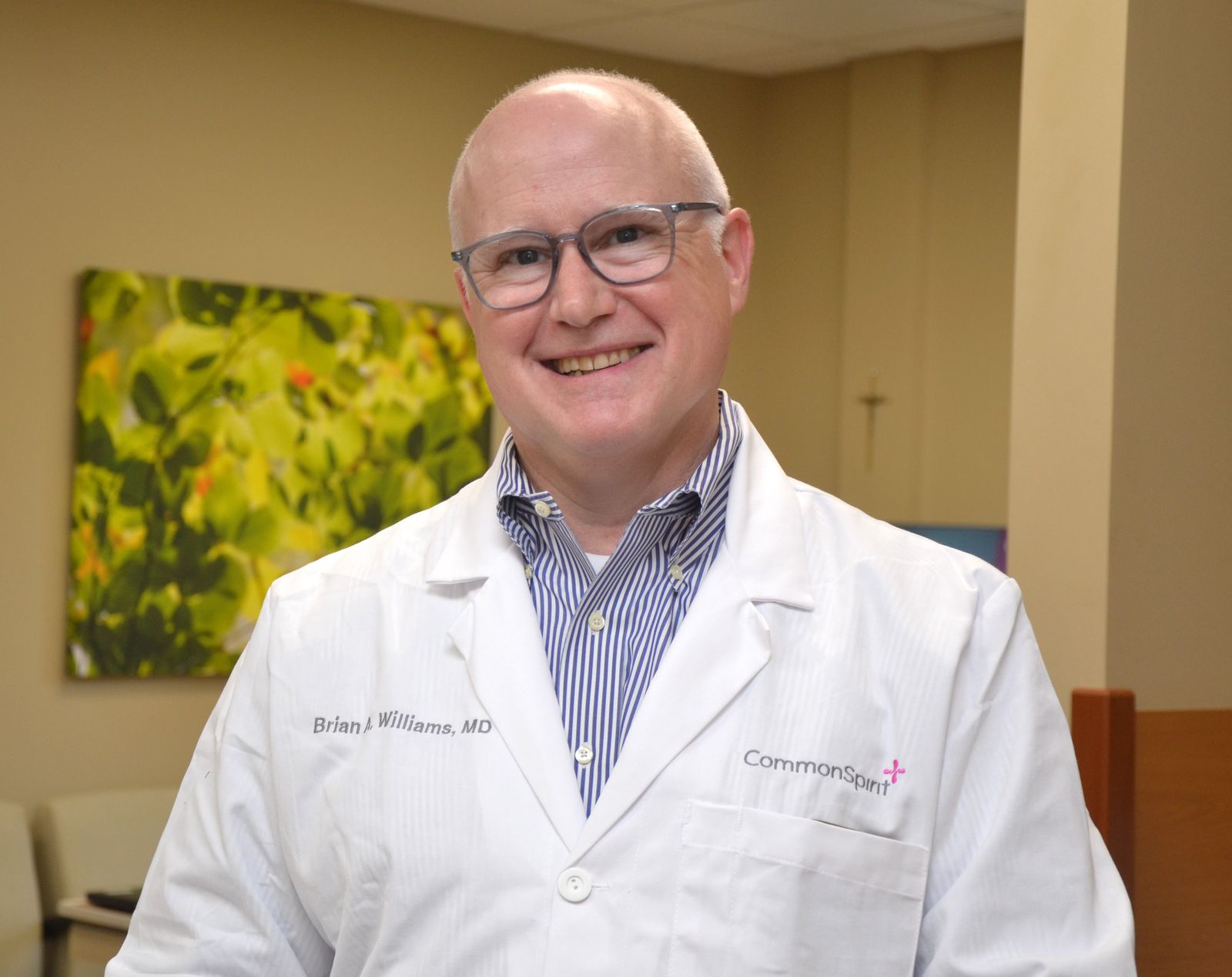
A conversation with Brian Alex Williams, MD, radiation oncologist, CommonSpirit – Saint Joseph Hospital – Bardstown
Editor’s note: During his 30-minute lunch break, we recently sat down with Dr. Brian Alex Williams to discuss changes, innovations, and challenges in radiation oncology, particularly in a rural healthcare setting.
MDU: Please tell us about your background, where you grew up, your education and training.
Williams: I grew up in Georgetown, Kentucky, and attended Scott County High School. I graduated college with a BA in English in 1992 from the University of North Carolina Chapel Hill. Then I decided I wanted to go to medical school, so I completed a second bachelor’s degree in mathematics with my pre-med requirements at Georgetown College. I received my medical degree from the University of Kentucky College of Medicine in 2000.
MDU: Are there any other doctors or healthcare providers in your family?
Williams: I have an aunt who is a retired pediatrician.
MDU: When and why did you choose oncology as your specialty and the special area of radiation oncology?
Williams: In medical school, radiation oncology caught my eye because it involved physics and mathematics and it was something I would be well suited for.
MDU: When did you join the CommonSpirit Health?
Williams: I have been working in the Saint Joseph Hospital and CommonSpirit Health system since 2015.
MDU: Describe your typical work week.
Williams: On Mondays, I see patients in Lexington at the Cancer Center at Saint Joseph Hospital. Tuesday through Friday, I work at the Cancer Center in Bardstown. Several days a week we have clinical conferences at 7:00 AM, so I arrive at the office around 6:00 or 6:30. I was never a morning person before medical school, but life has turned me into one.
My typical day involves clinic appointments with new patients, patients under treatment, or follow-up patients. I work on designing radiation treatment plans. This involves using specialized software that is somewhat similar to computer-aided design programs employed by engineers. My work involves a lot of communication with other members of the treatment team. For example, the medical dosimetrist is to my work what a pharmacist is to many other doctors. There’s a lot of back-and-forth communication with the dosimetrist throughout my day. There is also a lot of communication with the patient’s medical oncologist. One of the aspects I love about working in Bardstown is the medical oncologist, Dr. Patrick Williams, is in the same office and that facilitates collaborative discussion.
MDU: Kentucky is known for a population with a lot of heart disease and cancer. Genetics and lifestyle factors such as unhealthy diet, lack of exercise, and smoking are contributing causes. Have you seen this in your patient population?
Williams: I do see a large number of cancers related to smoking, and in Bardstown I see many skin cancers related to sun exposure. Patients with pre-existing conditions such as diabetes or COPD face additional challenges during the treatment of their cancers. That said, a large proportion of cancers are sporadic rather than related to familial genetics.
MDU: Tell us about some of the challenges and innovations that are occurring in rural health cancer care at CommonSpirit in Bardstown.
Williams: One of the challenges is expediting cancer care in a rural setting. Patients may live a long way from the hospital, which presents a logistical challenge for them. In an urban setting it is easier to shorten the time between initial diagnosis and treatment. Making rural cancer care more time-efficient is something we are continuously working on.
MDU: Please talk about the collaboration with your colleagues and how it advances care for the rural Kentucky cancer patient population.
Williams: The practice uses internet video-conferencing for communicating with other providers. For instance, I have a weekly peer review conference with other radiation oncologists in Lexington, London, and Hot Springs, Arkansas. This is basically a continuous quality improvement process in which we review each other’s plans and make constructive criticism or help each other solve unusual clinical dilemmas that may arise.
Our Tumor Board is a regular weekly conference that involves surgeons, medical oncologists, radiation oncologists, pathologists, diagnostic radiologists, and other professionals such as medical geneticists, social workers, and dieticians, to discuss new cancer cases. This is especially useful to brainstorm treatment approaches for unusual cases, and to see if there are any clinical trials that a patient may be eligible for.
The electronic health record has a feature that lets us send messages to other providers. This is especially handy when I have a patient in Bardstown who is receiving some part of their cancer care with a doctor in Louisville or London or wherever. It makes it easier to coordinate care so that everybody is on the same page. One example is in the treatment of gynecologic cancers, which often involves a portion of radiation therapy over several weeks here in Bardstown, followed by a brachytherapy, which is done in Louisville. There is a lot of back-and-forth communication that ensures coordination of care.
MDU: What role do you see for AI in radiation oncology in the future?
Williams: One of the tasks for a radiation oncologist is to sit down at a computer and delineate the patient’s tumor in a 3D virtual model of the patient’s body. This model also includes the normal, non-cancerous tissues such as the heart and the spinal cord. We already have a program that is doing some of that work, but it’s not perfect at this point. I anticipate that a human oncologist will always have to make final edits and tweaks to a computer’s work.
Often in radiation oncology we fuse the images of one scan with another. For example, in planning treatment for a lung cancer patient who has had a PET-CT, we will fuse the PET-CT with our treatment plan. However, the patient’s body position is inevitably not identical from one scan to the next, and so it is a laborious and time-consuming task for a human, and we generally have to prioritize the fusion to the area we plan to treat. Using AI would allow for doing a rapid, virtual repositioning of the patient so that the two scans have more precise alignment. This is currently an emerging technology and I anticipate it will become more widespread, accurate, and rapid in the future.
I would not be surprised to see AI employed to rapidly integrate a wide variety of information on a patient, and thus guide clinicians on treatment decisions. For example, suppose a lung cancer patient has a PET-CT scan which shows a suspicious new lesion in the liver but it is ambiguous whether this represents a metastatic lesion or not. An AI program could conceivably be able to rapidly evaluate the radiographic findings with the patient’s lab results, the tumor genetics, the prior treatment history, and be able to advise the doctor that a biopsy is or is not worthwhile at this point.
MDU: What is your motivation? What’s your “why” for being a radiation oncologist?
Williams: My general motivation to become a doctor was to help people, and the field of radiation oncology stood out to me as a particular branch of medicine that would be a good fit for me because it involves physics and mathematics. I’m not literally curing patients with calculus, but there is a good bit of my work that involves mathematics or is math-adjacent. Treatment planning, somewhat like doing a mathematical proof, is a process of creative problem solving within a framework of guidelines. I find the work engrossing and satisfying. That said, the practice involves a lot of old-fashioned face-to-face communication with patients and their families. The high-tech aspect of the field mainly goes on behind the scenes. About half my time is spent talking to patients, educating them on their cancer and their treatment plan, answering their questions. I strive to be approachable and to be a good communicator, and patients seem to appreciate that. I probably use my English degree as much as my math degree in that respect. I have learned over the years that if you take the time to educate the patient and answer their questions, they generally have less anxiety and more confidence as they go through the treatment process. That goes a long way in making a stressful experience a little more bearable.