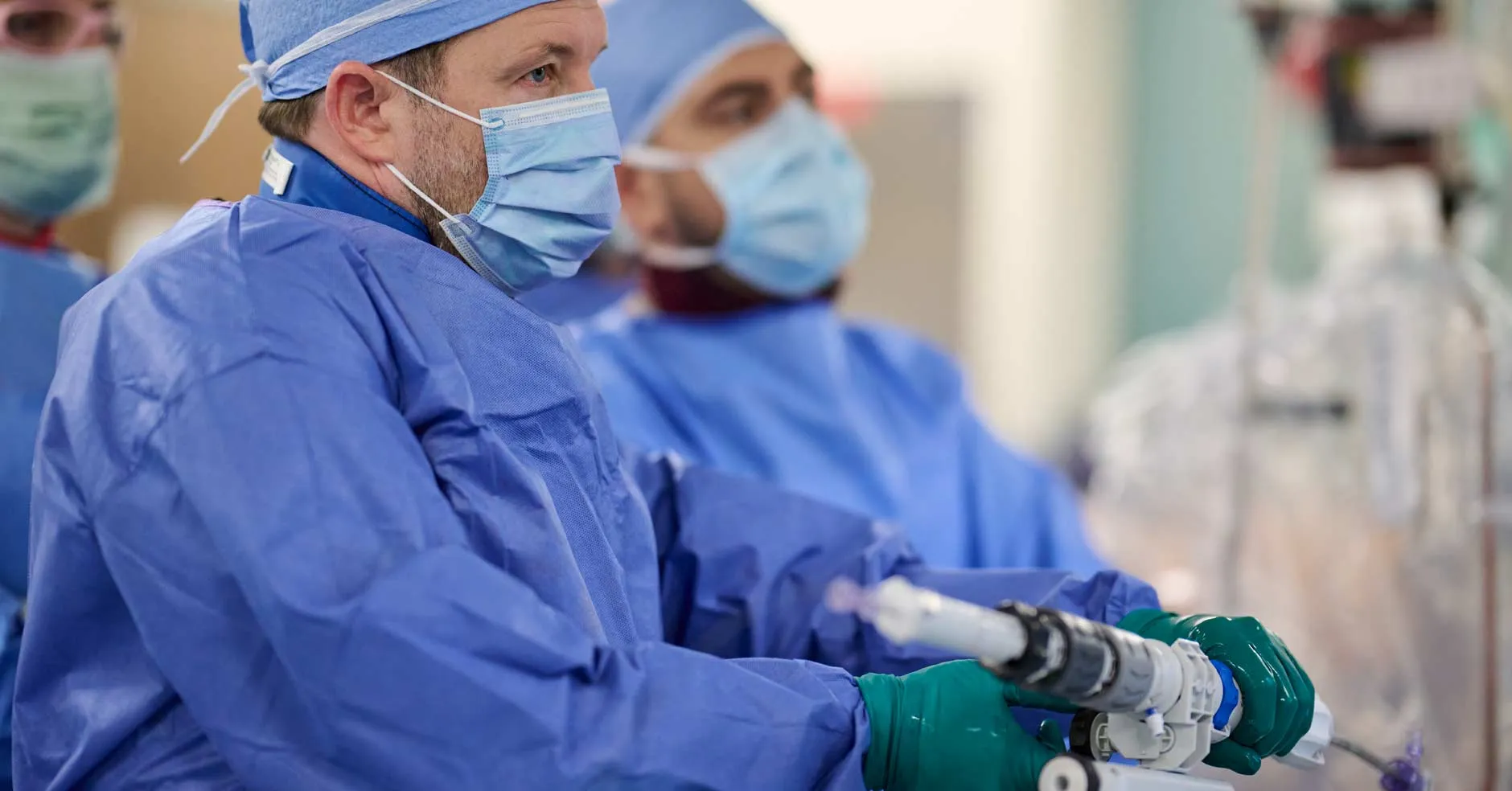
LOUISVILLE — The Norton Heart & Vascular Institute strives to be the regional leader in the provision of cardiovascular care. As the System Director for Interventional and Structural Cardiology for Norton Healthcare in Louisville, D. Sean Stewart, MD, merges the needs of patients seen in clinic with cutting edge diagnostic and therapeutic modalities to achieve that goal.
The son of a Louisville neonatologist, Dan L. Stewart, MD, the younger Dr. Stewart has known since eighth grade that he wanted to be a physician within the cardiovascular space. After graduating from Ballard High School, he attended Vanderbilt University and returned home to the University of Louisville for medical school.
During Stewart’s college days, his grandfather, who lived in eastern Kentucky, suffered a heart attack. Stewart noticed the quality of care his grandfather received was not as comprehensive as what he would have received in Louisville. Stewart’s father Dan, advocated for his grandfather to be transferred to Louisville, where he received a coronary artery bypass grafting procedure that ultimately saved his life. Sean Stewart believes that, without that advocacy, his grandfather’s outcome would not have been a positive one. “I think that was part of the genesis for my passion for cardiovascular medicine and I’ve never drifted away from that focus,” he says.
After a residency in internal medicine at the Medical University of South Carolina, Stewart completed a cardiology fellowship at the University of Louisville. He then completed an additional year of advanced fellowship training in interventional cardiology at the University of Connecticut. Stewart returned to Louisville in 2010 and ultimately joined Norton Healthcare in 2015, where he is entering his 11th year with the Heart & Vascular Institute.
Connecting With Patients Is Essential
A week in Stewart’s professional life is a combination of seeing patients in the office, performing complex coronary and structural procedures, and helping to build Norton Healthcare’s interventional and structural programs.
On clinical days, Stewart meets with patients to obtain a comprehensive review of their health history, garnering a keen understanding of their current problems, and formulating a plan of care to achieve their goals.
“I think two of our program’s strongest attributes are our transparency and honesty. I truly pride myself on being a fiduciary to the patients that we treat. I am proud to say that our program has never strayed from that principle,” says Stewart.
Though he sees patients that range in age from 18 to over 100 years of age, the majority of his patients are older baby boomers. The population, in general, is living longer and thus developing more cardiovascular problems, including both coronary and valvular issues. Because they are older, these patients often do not do as well with traditional open-heart surgery. As such, Stewart has pursued the attainment of aggressive therapies to treat these patients with minimally invasive techniques.
Growing the Structural Program
Transcatheter aortic valve replacement, TAVR, has advanced rapidly since first becoming commercially available in 2011. By 2016, the number of transcatheter aortic valve replacements outpaced surgical aortic valve replacement. Under Stewart’s direction, Norton Healthcare has increased the volume of this procedure rapidly, now leading the state in the total number of these procedures performed annually.
“With this success, we started to look at options to repair or replace some of the other cardiac valves in a minimally invasive manner,” Stewart says. “We have now been able to repair or replace many other cardiac valves via minimally invasive techniques.”
One advancement in structural cardiology that is particularly exciting for Stewart is the Edwards EVOQUE transcatheter tricuspid valve replacement. Stewart sees a significant number of patients with leaky tricuspid valves who would benefit from repair or replacement but are not ideal candidates for the other procedures currently available to do so.
“And that is where, to me, EVOQUE is so exciting. EVOQUE is the first commercially available non-aortic percutaneous valve replacement in patients without a previous surgical procedure. I am thrilled that our team at Norton Healthcare is the first in the state to implant it,” he says.
“What this does is help us treat patients more effectively that have severe tricuspid regurgitation, who often have significant symptoms of fatigue and shortness of breath. That’s a big deal for our community and really impacts quality of life.”
EVOQUE is not the only new technology Stewart is excited to bring to the community. He is looking forward to a commercially available mitral valve replacement, projected to be available later this year. “I’m excited about a potential percutaneous mitral valve replacement that is based on the EVOQUE platform. We have a lot of patients that I think would really benefit from a percutaneous mitral valve replacement, because they’re not candidates for a transcatheter edge-to-edge repair and they’re not optimal surgical candidates because of their age or other medical issues,” he says.
Regardless, Stewart encourages earlier referral of those patients with significant valvular issues to a multi-disciplinary structural heart clinic, like the one offered at Norton Healthcare. “Earlier referrals remain of paramount importance. This tends to afford patients more treatment options and usually, better outcomes,” says Stewart.
Importance of Aggressive Medical Therapy
A popular misconception that Stewart encounters is that “People think that the predominance of coronary artery disease comes from the fact that they eat poorly. The vast majority of this is genetics. It’s not so much how you eat, although it does have some effect, but it’s how your body processes and deals with cholesterol.”
“Diet and exercise are important, and we don’t want to discourage people from looking after themselves in general,” Stewart says, but he believes “We need to focus more on trying to get people on aggressive medical therapies and, potentially even evaluating them earlier for coronary artery disease.” Stewart notes that the new guidelines for cholesterol management dictate lower targets for bad cholesterol. He also notes the importance of optimal blood pressure control and the need for monitoring for other contributory conditions to coronary artery disease, such as diabetes and tobacco use.
To assist in those early interventions, Norton Healthcare has established both metabolic and hypertension clinics. Norton Healthcare has also expanded its utilization of coronary computed tomography scans to allow for more accurate and potentially earlier detection of coronary artery disease via a minimally invasive approach.
Restoring Quality of Life
Likewise, some patients with known coronary artery disease have been told that nothing can be done to fix it. Similar opinions have also been rendered to patients in the structural space as well. Stewart encourages many of these patients to seek second opinions. “I am glad that I have been able to help many of these patients with more complex coronary and structural issues,” Stewart says.
For example, Stewart remembers a gentleman with a complicated cardiac history who had sought treatment at multiple centers throughout the region but had been unable to find anyone who could help him. Luckily, he connected with Stewart, and after a complex coronary procedure, went from being debilitated with angina to being able to perform all his activities again. Stewart says, “It was truly rewarding to be able to give him a quality of life back.”
Stewart and Norton Healthcare are proud to work with and provide options for patients to achieve their health goals. “I think we really strive to make sure that we are doing the right thing for our patients,” says Stewart. “I’m extremely honored to work for Norton Healthcare; we seem to have the right moral compass as an institution.”