LOUISVILLE — One of the biggest misconceptions that interventional cardiologists face is that any patient visit to them will result in a stent, says Yuvraj Chowdhury, MD.
“My job isn’t just to open arteries — it’s to understand when and why intervention is needed, and when a patient is better served by medical therapy or lifestyle change.”
Chowdhury, an interventional cardiologist at UofL Health, and director of the cardiac cath lab, says, “I’m trained not only in complex coronary interventions, but also in noninvasive cardiology, including nuclear cardiology, and echocardiography. That background allows me to see the whole picture before ever reaching for a catheter. I also believe deeply in the power of prevention. A large part of what I do involves helping patients understand their disease, modify risk factors, and take ownership of their heart health. Because the best procedure is the one you never need — and empowering patients to avoid that path is just as rewarding as performing a successful intervention.”
Chowdhury grew up in India, in a town at the foothills of the Himalayas. After attending Bharati Vidyapeeth Deemed University Medical College to obtain his bachelor’s degree in medicine and surgery, he did his internal medicine residency at St. Peter’s University Hospital, Rutgers-Robert Wood Johnson Medical School.
“I was fortunate to receive the Maulana Azad national scholarship, which was awarded to me by the President of India,” he says. “That recognition really set me on the path that would eventually lead me halfway around the world. After earning my degree in India, I came to the United States to further my training.”
At St. Peter’s, he served as chief resident. From there he completed a fellowship in cardiovascular medicine at State University of New York where he was elected chief fellow. This was followed by a fellowship in Interventional Cardiology at the University of Massachusetts in Worcester, where he specialized in complex cardiology interventions, mechanical circulatory support, advanced pulmonary embolism interventions, and interventional management of advanced cardiogenic shock.
All in the Family
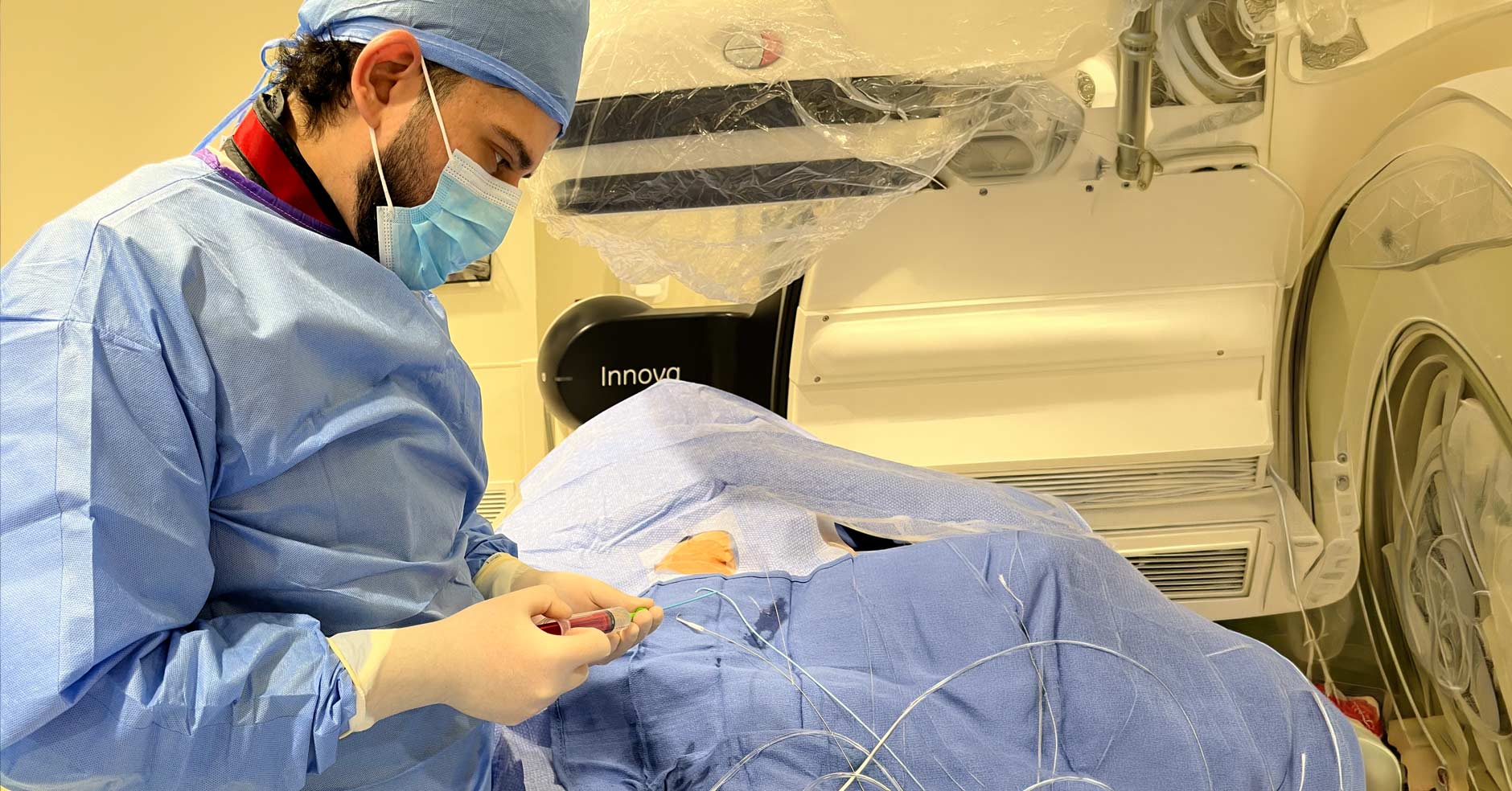
Now at UofL Health, Chowdhury specializes in treating patients with coronary artery disease as well as patients with pulmonary embolisms. Apart from placing stents, he’s treating patients by removing clots from their lungs and using percutaneous techniques to close PFOs or “holes in the heart.”
“I take care of the sickest of the sick,” he says. “It is a privilege of bringing people back from the brink.”
Treating patients with cardiac issues is personal for Chowdhury. Not only is medicine something that runs in the family, but cardiovascular health issues took his grandfather. Chowdhury’s wife, Mrin Shetty, MD, is an advanced multi-modality imaging cardiologist and director of the Women’s Heart Program at UofL Health. Chowdhury’s father-in-law is a renowned cardiac surgeon in Mumbai whose work has inspired a generation of young surgeons. His great-grandfather was also a physician and is known for his work on snake venom research in India.
Choosing cardiology as a specialty came from his experiences watching his father deal with heart disease and his grandfather deal with a stroke.
“I think those experiences introduced me to the fragility of the cardiovascular system long before I ever even stepped into a cath lab,” he says. “Those experiences made the science deeply human for me. That’s why every case still feels so personal. In training, I discovered that I thrived in an environment where precision meets pressure, where the outcome hinges on timing, skill, and calm decision-making.”
Seconds Matter in the Cath Lab
A fascination with the intricacies of hemodynamics and how subtle shifts in flow resistance can have impacts on a patient’s health led to his career in the cath lab where, he says, doctors can turn physiology around in real time.
“Advanced mechanical circulatory support and device innovation became extensions of that passion, allowing me to guide the course of management for our patients in cardiogenic shock due to massive myocardial infarction, where seconds really matter,” he says. “The same mindset extends to my interest in pulmonary embolism intervention. It’s another time-sensitive, life threatening scenario where endovascular expertise can be the difference between survival and loss.”
Chowdhury and his wife joined UofL Health in 2023, largely because of the program’s potential to grow, he says. The facility serves as the focal point of heart care in the region, which allows him to best use his skills in complex coronary interventions and pulmonary embolism therapies.
While coronary interventions are the cardiologist’s bread and butter, Chowdhury says, other treatments, like pulmonary embolism intervention and micro-vascular dysfunction testing, can be just as lifesaving.
“Pulmonary embolism intervention is something I’m doing more and more of, as awareness around it is increasing,” he says. “We have developed a highly effective protocol in collaboration with vascular surgery, interventional radiology, the ER, and the critical care unit for the management of these conditions. Treatment options vary by severity but also specialty. Many can be managed with blood thinners, but high acuity patients require invasive interventions, and that can include extracting that clot from a blocked artery in the lungs to restore circulation, potentially saving their life, or infusing clot busting medication directly into the arteries where the clot is, thereby restoring flow.”
Restoring Quality of Life
“Here we are not just performing procedures, we are building a regional hub for advanced cardiovascular care capable of treating the sickest patient. I think those things really drew both of us,” he says.
A High-Risk Patient Population
Most of his patients are middle aged and older, but there are quite a few younger adults that he sees. The patient population is diverse and ranges from those with advanced coronary disease to those with adult congenital heart disease. He has a reputation for taking on high-risk patients that others might turn away.
Increasingly, he says, the practice is caring for patients with complex coronary disease and pulmonary embolism that are referred to the practice from hospitals around Kentucky and southern Indiana.
“They’re often critically ill patients, and with timely catheter directed interventions, we are able to restore circulation and prevent long-term complications,” he says.
“This is an incredibly exciting time for interventional cardiology. We’re moving from a one-size-fits-all approach to truly precision-guided care,” he says. “Advances in intracoronary imaging now allow us to see the vessel in microscopic detail and tailor every stent to the patient’s individual artery. That really has improved outcomes and the longevity of these stents.”
“With mechanical circulatory support, we can now safely perform complex interventions in the sickest hearts — providing temporary support without opening the chest or placing patients on heart-lung bypass. It’s changed what’s possible for those once considered too high risk.”
And as we start to see a second wave of patients with blocked prior stents, drug-coated balloons are an elegant solution, allowing us to recanalize arteries without adding new metal, restoring flow and durability with less long-term risk.
Pulmonary embolism disproportionately affects women and does not spare the young. Interventional approaches to treat this can stave off long-term complications.
“For a lot of young people, it preserves their quality of life, where they’re able to live a robust life — go for a hike, enjoy time outdoors. And to do those things without functional limitations. In the past, we were just managing with medications and not achieving the same results.”
“There’s nothing like watching a patient go from critical to stable because of something you did with your own hands and heart. That’s what keeps me showing up – not the titles, not the technology, but the privilege to restore life when it’s slipping away. I think that’s my strongest why,” he says.
“A lot of times I meet these people at their weakest moment. There’s a family out there waiting; they’re distraught; they don’t know what the next couple of hours are going to look like. But once the dust settles, and health is restored, you get to go in and restore hope… it’s such a beautiful feeling to wrap up your day like that, to have made that difference, to have changed a life, to change the entire trajectory of what could have happened.”