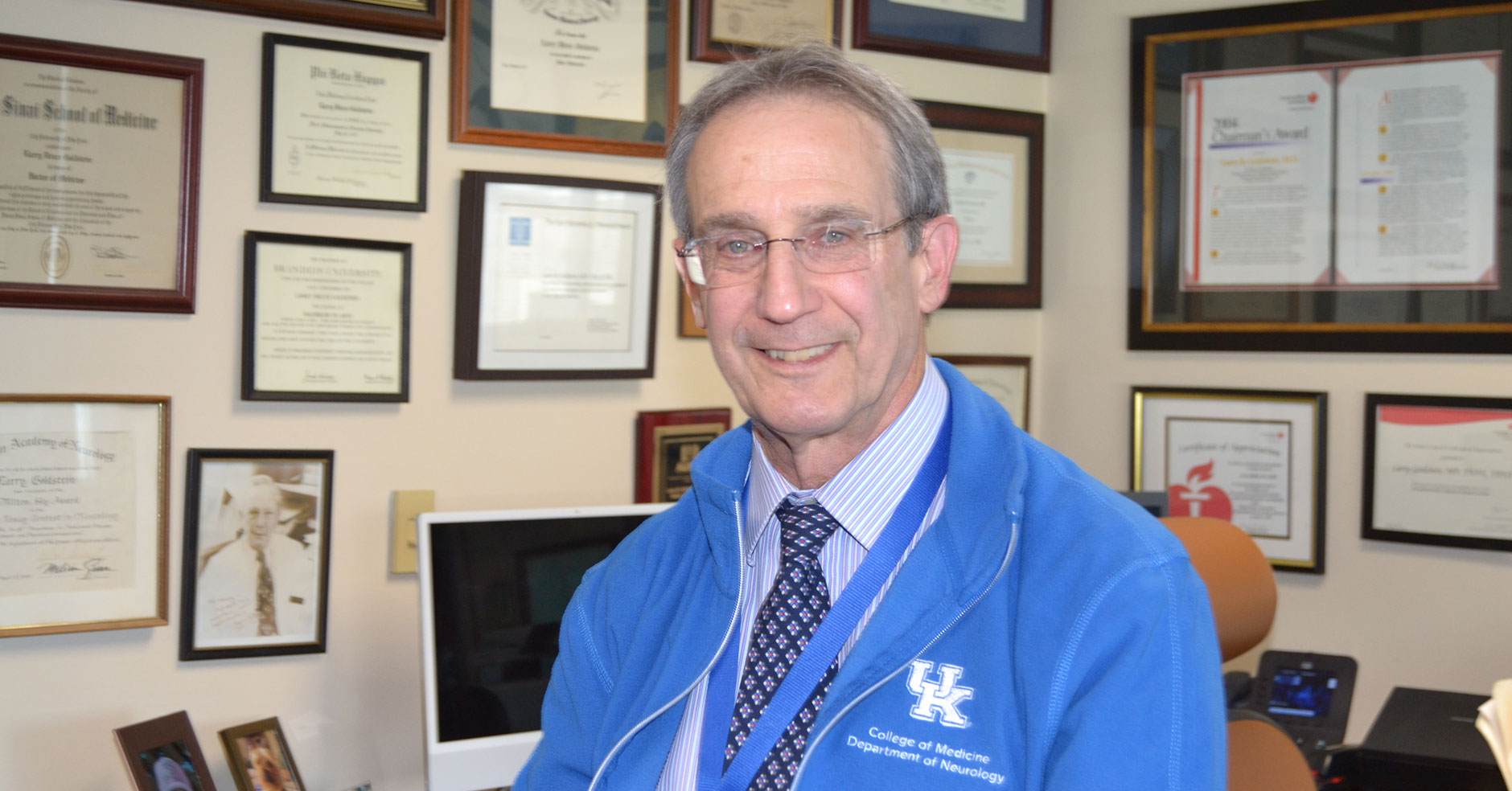
Larry B. Goldstein, MD, wears many hats as he works to expand neurologic care in Kentucky.
LEXINGTON Kentucky is among the southeastern states known as the “Stroke Belt,” a section of the country that sees the highest numbers of stroke-related deaths in the country. Larry Goldstein, MD, chair of the University of Kentucky’s Department of Neurology, is trying to change that.
In addition to his faculty duties, Goldstein serves as co-director of the Kentucky Neuroscience Institute (KNI) and the UK Neuroscience Research Priority Area (NRPA), and is the co-chair of the Kentucky Heart Disease and Stroke Prevention Task Force, medical director for the UK-Norton Healthcare Stroke Care Network, and a member of the board of directors of the American Academy of Neurology.
When Goldstein came to the University of Kentucky from Duke in 2015, people told him, “Oh, you’re from Duke. You know we don’t like Duke.” Luckily, in this case, Duke’s loss is UK’s gain.
It All Started with Goldfish
Goldstein’s interest in neuroscience began in a high school AP biology class where an article in Scientific American about memory in goldfish piqued his interest. To further explore the subject, he converted an old storage room into a lab, installed 50 tanks filled with goldfish, and designed an experiment to test their memory.
The experience stayed with Goldstein. “It informs a lot of the things that we do now at UK because I really believe that starting and planting seeds early sets people on tracks, sometimes for the rest of their lives.”
Goldstein grew up on Long Island, New York, before attending Mt. Sinai School of Medicine in New York City where he also completed a neurology residency followed by a stroke research fellowship at Duke, where he then joined the faculty and eventually became the stroke center director.
After 30 years at Duke, Goldstein began looking for opportunities to broaden his contributions. At the same time, UK was searching for a department chair in neurology. Goldstein wanted to build a unique program, one that didn’t currently exist in the country. Recognizing that UK had the resources and the will to build that program, he made the move to Lexington.
Multidisciplinary Approach Critical to Neurologic Care
The mission of KNI is to “provide care for patients with complex neurological disorders so they don’t need to leave the Commonwealth of Kentucky for care.”
Neurology is a very large, complex field. Goldstein has about 70 full-time faculty as well as close to 50 residents, 25 advanced practice providers, either physician assistants or advanced practice nurses, and 10 fellows. It’s very subspecialty divided.
In addition to the College of Medicine, the University, and UK HealthCare, neurology faculty also collaborate with the Markey Cancer Center and the Sanders-Brown Center on Aging. Many of the faculty who work in those centers have their academic homes in neurology.
KNI closely integrates faculty from neurology and neurosurgery for specific neurological conditions. Examples include stroke, medically refractory epilepsy, and movement disorders.
“What we’re trying to do is focus on the problems, focus on the patients, focus on the research areas, and focus on the educational programs,” he says.
Disease Is Complicated in Kentucky
For decades, Kentuckians have had multiple comorbidities including heart disease, diabetes, obesity, and cancer. Many hypotheses have been put forward to explain the causes, but no one reason explains the rates of chronic disease in the state.
It’s probably partly environmental, but also based on diet, nutrition, lack of exercise, smoking, and limited access to healthcare. “Our social determinants of health in Kentucky are major drivers of pretty significant chronic diseases,” Goldstein says.
There is reason for optimism, though. Goldstein points to a recent study from UK that compared counties in the state that have the highest morbidity rates from stroke against those that have the lowest.
Accounting for social and lifestyle factors in those counties, the study found that patients living in counties with high stroke mortality rates who have access to high-quality stroke care have outcomes that are similar to those in low-mortality counties.
Simply put, “Access to good healthcare makes a difference,” Goldstein says.
Leading the Way in Multidisciplinary Research
Goldstein and his associates research topics focused on the core missions of KNI: clinical care, education, innovation, developing new knowledge, and service to the people of Kentucky. There are currently 52 trials at various stages being conducted out of neurology alone. Clinical research is being carried out in stroke, epilepsy, headache medicine, multiple sclerosis, movement disorders, Alzheimer’s disease and other dementias, neuromuscular diseases, sleep, neuro-oncology, and neuro-imaging, among others.
These trials benefit current patients too. Goldstein says, “It really allows us to bring new therapies or new potential therapies to patients and offer them the chance of participating in the studies that are trying to develop new knowledge and make a difference. Usually, those trials are in areas where we don’t know what the right thing to do is.”
Neuroscience is one of the Research Priority Areas (RPA) at UK. Around 330 faculty from nine colleges and 42 departments are doing neuroscience-related research at the university. The Neuroscience RPA (NRPA) provides broad-based support for neuroscience research campus wide. One of the programs under the NRPA is the NeuroBank. This program collects blood, tissue, and cerebrospinal fluid, most of which were set to be discarded, from current patients. The samples are linked to the patient’s medical records, so if scientists are looking for material needed for a study, they can go to the NeuroBank first instead of having to start from scratch.
Expanding Healthcare across the State
In order to spread high-quality healthcare to other parts of the state and region, UK, in conjunction with Norton Healthcare, set up a Stroke Care Network. Currently, 41 hospitals from Kentucky, southern Indiana, and western West Virginia are members of the network with the goal of optimizing stroke-related outcomes. This allows patients to stay in their home communities unless they require advanced services that aren’t available locally.
Artificial intelligence (AI) provides another resource to promote community-based care. Another UK program uses software installed on the CT scanners in emergency departments to identify stroke patients who might benefit from physical removal of a blood clot closing a brain artery.
Physicians at UK receive an alert on their smartphone if the AI detects a possible closed brain artery. They then can contact the local hospitals and consult with the physicians treating that patient using the same software. If the patient might benefit from an advanced procedure not available locally, they can expedite the transfer of that patient to UK.
Child neurology is another example of providing advanced care beyond UK’s Lexington campus. Robert Baumann, MD, from UK’s Department of Neurology, worked with the state (the Kentucky Office for Children with Special Healthcare Needs) to establish child neurology clinics in rural Kentucky. Faculty, residents, and students go to those locations on a rotating basis to provide care that would otherwise have required patients to travel to Lexington or Louisville, where all of the state’s child neurologists are based.
It goes back to the university’s service mission, dating to its establishment as a landgrant institution in 1865, Goldstein says. “We’re doing all these things to improve the care and health of patients across the state by partnering with local hospitals, partnering with the state, and developing programs to get patients the care that they need, when they need it, and where they need it, but keeping as many in the state as we can.”
The Future of Neurology
Neurological care is advancing rapidly and is becoming increasingly sub-specialized. Progress requires coordinated health care systems to be in place for the right patient and at the right time. For stroke, for example, Goldstein points to the use of statins and PCSK9 inhibitors to lower LDL levels below even 70 mg/dL as a recent research breakthrough. “It reduces the risk of stroke, cardiovascular disease, and other cardiovascular complications without any major complications or side effects. Combined with lifestyle interventions, blood pressure control and other new preventive therapies, and the use of clot-busting drugs and physical clot removal for those who have had a stroke, we have the opportunity to reduce the burden of stroke across the state.
“It’s really pretty amazing,” he says. As Goldstein sees it, “the biggest challenge facing neurology at the moment is a workforce issue. There is a 25% gap between the demand for neurologic care and the supply of neurologists to provide that care. Combine that with all of these new, but very complicated therapies that are becoming available and that need providers with particular expertise to be able to use them and use them safely in the right patients.”
When Goldstein arrived in 2015, neurology had 18 faculty members at UK. That’s now up to 70 with many more recruitments in process. Our educational programs are key. If we give medical students a good experience in neurology, many will want to dedicate their careers to our field. By attracting outstanding residents and fellows, many will want to stay in the state to provide care. His mantra is “Train and retain,” in support of the UK HealthCare and KNI missions: to be of service to the college, the university, the state, and the people who live here. Our strength is our ability to integrate our educational, research, clinical care, and service missions – the true advantage of having an academic medical center integrated into a university with a college of medicine.
Patient volumes are also increasing under Goldstein’s watch. According to the 2024 KNI annual report, outpatient visits by fiscal year were:
| Child Neurology | Multiple Sclerosis | Movement Epilepsy | Disorders | |
|---|---|---|---|---|
| 2024 | 7,701 | 1,637 | 6,353 | 4,596 |
| 2023 | 5,793 | 1,171 | 6,025 | 4,411 |
| 2022 | 5,224 | 1,495 | 5,613 | 4,174 |
| 2021 | 4,645 | 1,392 | 5,448 | 3,982 |
For stroke patients in Kentucky in 2024, UK HealthCare performed 40% of all acute interventions with an average of 35 minutes in “Door-to-needle” time. The KNI was awarded the designation of Comprehensive Stroke Center by The Joint Commission, rated “High-Performing in Stroke” by U.S. News & World Report for 2024/2025, and Get with the Guidelines Gold Plus and Target Stroke Honor Roll Elite Plus by the American Heart Association.
In Conclusion
And if you’re wondering if Goldstein’s alliance leans toward the Wildcats or the Blue Devils, he says, “Being a department chair and diplomatic, the answer is clearly, I root for the blue team.”